

Updated Nov 24, 2024 Verified Databricks-Certified-Data-Engineer-Associate dumps Q&As - 100% Pass
New 2024 Latest Questions Databricks-Certified-Data-Engineer-Associate Dumps - Use Updated Databricks Exam
NEW QUESTION # 51
A data analyst has a series of queries in a SQL program. The data analyst wants this program to run every day. They only want the final query in the program to run on Sundays. They ask for help from the data engineering team to complete this task.
Which of the following approaches could be used by the data engineering team to complete this task?
- A. They could only run the entire program on Sundays.
- B. They could wrap the queries using PySpark and use Python's control flow system to determine when to run the final query.
- C. They could automatically restrict access to the source table in the final query so that it is only accessible on Sundays.
- D. They could redesign the data model to separate the data used in the final query into a new table.
- E. They could submit a feature request with Databricks to add this functionality.
Answer: B
Explanation:
This approach would allow the data engineering team to use the existing SQL program and add some logic to control the execution of the final query based on the day of the week. They could use the datetime module in Python to get the current date and check if it is a Sunday. If so, they could run the final query, otherwise they could skip it. This way, they could schedule the program to run every day without changing the data model or the source table. Reference: PySpark SQL Module, Python datetime Module, Databricks Jobs
NEW QUESTION # 52
A data engineer is running code in a Databricks Repo that is cloned from a central Git repository. A colleague of the data engineer informs them that changes have been made and synced to the central Git repository. The data engineer now needs to sync their Databricks Repo to get the changes from the central Git repository.
Which of the following Git operations does the data engineer need to run to accomplish this task?
- A. Merge
- B. Push
- C. Commit
- D. Clone
- E. Pull
Answer: E
Explanation:
To sync a Databricks Repo with the changes from a central Git repository, the data engineer needs to run the Git pull operation. This operation fetches the latest updates from the remote repository and merges them with the local repository. The data engineer can use the Pull button in the Databricks Repos UI, or use the git pull command in a terminal session. The other options are not relevant for this task, as they either push changes to the remote repository (Push), combine two branches (Merge), save changes to the local repository (Commit), or create a new local repository from a remote one (Clone). References:
* Run Git operations on Databricks Repos
* Git pull
NEW QUESTION # 53
A data engineer wants to schedule their Databricks SQL dashboard to refresh once per day, but they only want the associated SQL endpoint to be running when it is necessary.
Which of the following approaches can the data engineer use to minimize the total running time of the SQL endpoint used in the refresh schedule of their dashboard?
- A. They can turn on the Auto Stop feature for the SQL endpoint.
- B. They can ensure the dashboard's SQL endpoint matches each of the queries' SQL endpoints.
- C. They can ensure the dashboard's SQL endpoint is not one of the included query's SQL endpoint.
- D. They can reduce the cluster size of the SQL endpoint.
- E. They can set up the dashboard's SQL endpoint to be serverless.
Answer: E
Explanation:
A serverless SQL endpoint is a compute resource that is automatically managed by Databricks and scales up or down based on the workload. A serverless SQL endpoint can be used to run queries and dashboards without requiring manual configuration or management. A serverless SQL endpoint is only active when it is needed and shuts down automatically when idle, minimizing the total running time and cost. A serverless SQL endpoint can be created and assigned to a dashboard using the Databricks SQL UI or the SQL Analytics API. References:
* Create a serverless SQL endpoint
* Assign a SQL endpoint to a dashboard
* SQL Analytics API
NEW QUESTION # 54
A data engineer is designing a data pipeline. The source system generates files in a shared directory that is also used by other processes. As a result, the files should be kept as is and will accumulate in the directory. The data engineer needs to identify which files are new since the previous run in the pipeline, and set up the pipeline to only ingest those new files with each run.
Which of the following tools can the data engineer use to solve this problem?
- A. Delta Lake
- B. Unity Catalog
- C. Databricks SQL
- D. Data Explorer
- E. Auto Loader
Answer: E
Explanation:
Auto Loader is a tool that can incrementally and efficiently process new data files as they arrive in cloud storage without any additional setup. Auto Loader provides a Structured Streaming source called cloudFiles, which automatically detects and processes new files in a given input directory path on the cloud file storage.
Auto Loader also tracks the ingestion progress and ensures exactly-once semantics when writing data into Delta Lake. Auto Loader can ingest various file formats, such as JSON, CSV, XML, PARQUET, AVRO, ORC, TEXT, and BINARYFILE. Auto Loader has support for both Python and SQL in Delta Live Tables, which are a declarative way to build production-quality data pipelines with Databricks. References: What is Auto Loader?, Get started with Databricks Auto Loader, Auto Loader in Delta Live Tables
NEW QUESTION # 55
A data engineer is working with two tables. Each of these tables is displayed below in its entirety.
The data engineer runs the following query to join these tables together: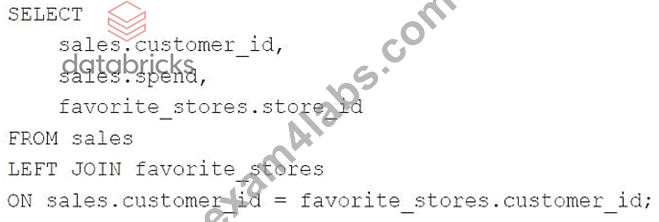
Which of the following will be returned by the above query?
- A. Option C
- B. Option E
- C. Option D
- D. Option A
- E. Option B
Answer: D
Explanation:
Option A is the correct answer because it shows the result of an INNER JOIN between the two tables. An INNER JOIN returns only the rows that have matching values in both tables based on the join condition. In this case, the join condition is ON a.customer_id = c.customer_id, which means that only the rows that have the same customer ID in both tables will be included in the output. The output will have four columns:
customer_id, name, account_id, and overdraft_amt. The output will have four rows, corresponding to the four customers who have accounts in the account table.
References: The use of INNER JOIN can be referenced from Databricks documentation on SQL JOIN or from other sources like W3Schools or GeeksforGeeks.
NEW QUESTION # 56
A data engineer is using the following code block as part of a batch ingestion pipeline to read from a composable table: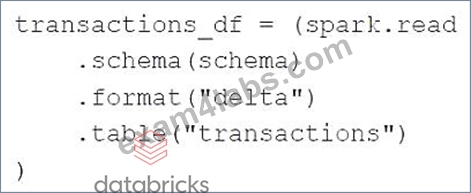
Which of the following changes needs to be made so this code block will work when the transactions table is a stream source?
- A. Replace spark.read with spark.readStream
- B. Replace format("delta") with format("stream")
- C. Replace schema(schema) with option ("maxFilesPerTrigger", 1)
- D. Replace predict with a stream-friendly prediction function
- E. Replace "transactions" with the path to the location of the Delta table
Answer: A
Explanation:
To read from a stream source, the data engineer needs to use the spark.readStream method instead of the spark.read method. The spark.readStream method returns a DataStreamReader object that can be used to specify the details of the input source, such as the format, the schema, the path, and the options. The spark.read method is only suitable for batch processing, not streaming processing. The other changes are not necessary or correct for reading from a stream source. References: Structured Streaming Programming Guide, Read a stream, Databricks Data Sources
NEW QUESTION # 57
A data analysis team has noticed that their Databricks SQL queries are running too slowly when connected to their always-on SQL endpoint. They claim that this issue is present when many members of the team are running small queries simultaneously. They ask the data engineering team for help. The data engineering team notices that each of the team's queries uses the same SQL endpoint.
Which of the following approaches can the data engineering team use to improve the latency of the team's queries?
- A. They can turn on the Auto Stop feature for the SQL endpoint.
- B. They can increase the maximum bound of the SQL endpoint's scaling range.
- C. They can increase the cluster size of the SQL endpoint.
- D. They can turn on the Serverless feature for the SQL endpoint and change the Spot Instance Policy to
"Reliability Optimized." - E. They can turn on the Serverless feature for the SQL endpoint.
Answer: B
Explanation:
https://community.databricks.com/t5/data-engineering/sequential-vs-concurrency-optimization-questions-from-q
NEW QUESTION # 58
Which of the following tools is used by Auto Loader process data incrementally?
- A. Checkpointing
- B. Unity Catalog
- C. Databricks SQL
- D. Data Explorer
- E. Spark Structured Streaming
Answer: E
NEW QUESTION # 59
In which of the following file formats is data from Delta Lake tables primarily stored?
- A. Parquet
- B. JSON
- C. CSV
- D. Delta
- E. A proprietary, optimized format specific to Databricks
Answer: A
Explanation:
Explanation
https://docs.delta.io/latest/delta-faq.html
NEW QUESTION # 60
A data organization leader is upset about the data analysis team's reports being different from the data engineering team's reports. The leader believes the siloed nature of their organization's data engineering and data analysis architectures is to blame.
Which of the following describes how a data lakehouse could alleviate this issue?
- A. Both teams would be able to collaborate on projects in real-time
- B. Both teams would reorganize to report to the same department
- C. Both teams would respond more quickly to ad-hoc requests
- D. Both teams would use the same source of truth for their work
- E. Both teams would autoscale their work as data size evolves
Answer: D
NEW QUESTION # 61
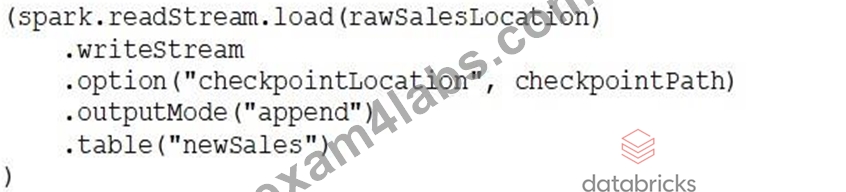
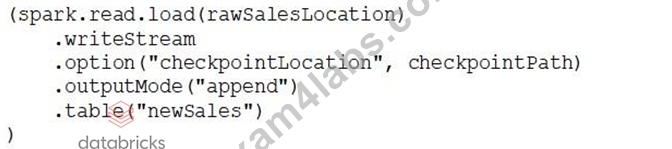
Which of the following Structured Streaming queries is performing a hop from a Silver table to a Gold table?
- A.
- B.
- C.

- D.
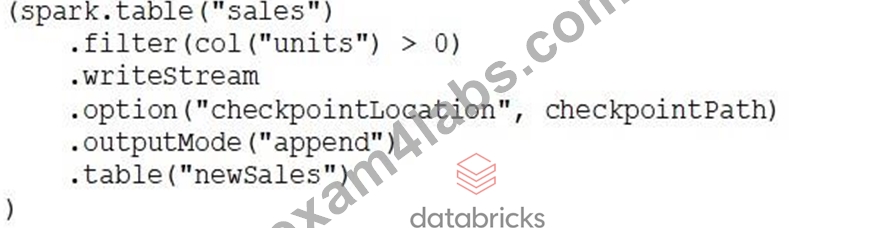
- E.

Answer: E
NEW QUESTION # 62
A data architect has determined that a table of the following format is necessary:
Which of the following code blocks uses SQL DDL commands to create an empty Delta table in the above format regardless of whether a table already exists with this name?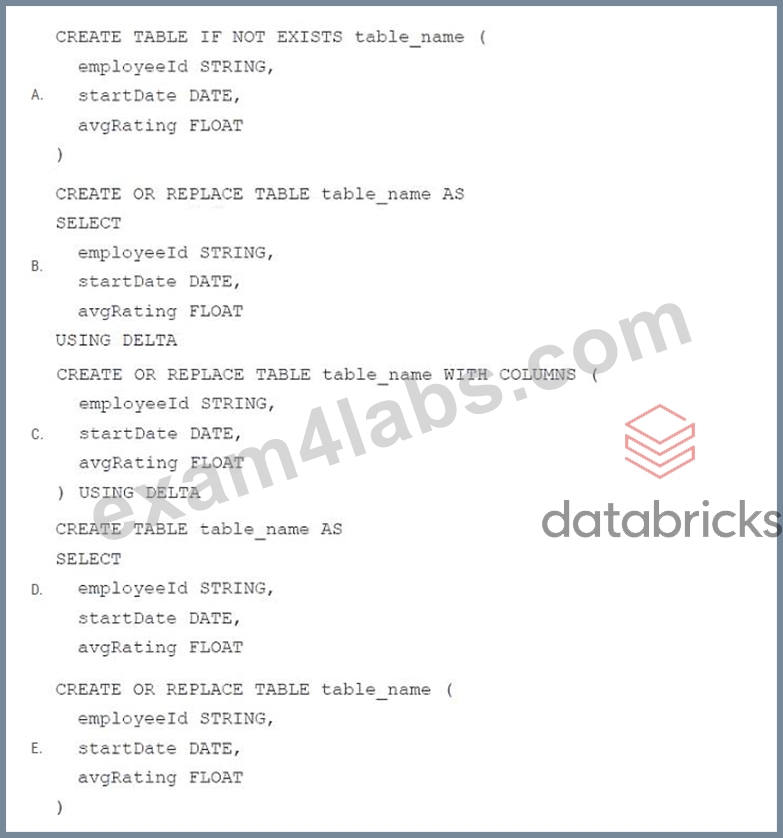
- A. Option C
- B. Option A
- C. Option D
- D. Option E
- E. Option B
Answer: D
NEW QUESTION # 63
A data engineer has configured a Structured Streaming job to read from a table, manipulate the data, and then perform a streaming write into a new table.
The code block used by the data engineer is below: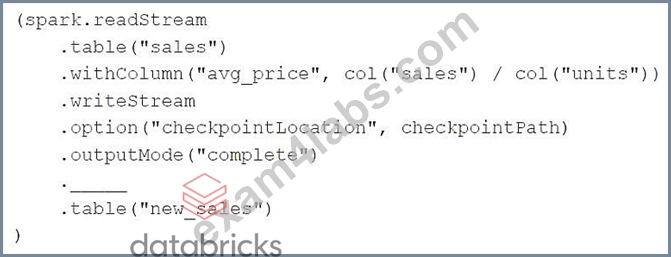
If the data engineer only wants the query to process all of the available data in as many batches as required, which of the following lines of code should the data engineer use to fill in the blank?
- A. trigger(availableNow=True)
- B. trigger(processingTime="once")
- C. processingTime(1)
- D. trigger(continuous="once")
- E. trigger(parallelBatch=True)
Answer: A
Explanation:
Explanation
https://stackoverflow.com/questions/71061809/trigger-availablenow-for-delta-source-streaming-queries-in-pyspa
NEW QUESTION # 64
A single Job runs two notebooks as two separate tasks. A data engineer has noticed that one of the notebooks is running slowly in the Job's current run. The data engineer asks a tech lead for help in identifying why this might be the case.
Which of the following approaches can the tech lead use to identify why the notebook is running slowly as part of the Job?
- A. There is no way to determine why a Job task is running slowly.
- B. They can navigate to the Runs tab in the Jobs UI to immediately review the processing notebook.
- C. They can navigate to the Tasks tab in the Jobs UI to immediately review the processing notebook.
- D. They can navigate to the Tasks tab in the Jobs UI and click on the active run to review the processing notebook.
- E. They can navigate to the Runs tab in the Jobs UI and click on the active run to review the processing notebook.
Answer: E
NEW QUESTION # 65
A data engineer has realized that the data files associated with a Delta table are incredibly small. They want to compact the small files to form larger files to improve performance.
Which of the following keywords can be used to compact the small files?
- A. COMPACTION
- B. REDUCE
- C. OPTIMIZE
- D. REPARTITION
- E. VACUUM
Answer: C
Explanation:
Explanation
OPTIMIZE can be used to club small files into 1 and improve performance.
NEW QUESTION # 66
A data engineer has configured a Structured Streaming job to read from a table, manipulate the data, and then perform a streaming write into a new table.
The cade block used by the data engineer is below: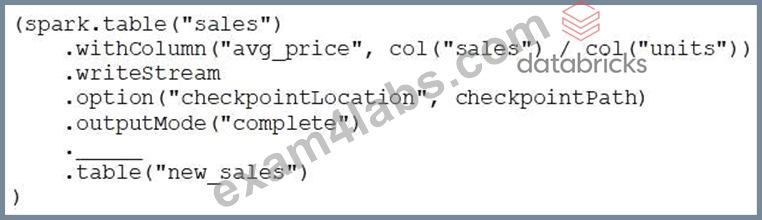
If the data engineer only wants the query to execute a micro-batch to process data every 5 seconds, which of the following lines of code should the data engineer use to fill in the blank?
- A. trigger(continuous="5 seconds")
- B. trigger()
- C. trigger("5 seconds")
- D. trigger(once="5 seconds")
- E. trigger(processingTime="5 seconds")
Answer: E
Explanation:
Explanation
# ProcessingTime trigger with two-seconds micro-batch interval
df.writeStream \
format("console") \
trigger(processingTime='2 seconds') \
start()
https://spark.apache.org/docs/latest/structured-streaming-programming-guide.html#triggers
NEW QUESTION # 67
A data engineer wants to schedule their Databricks SQL dashboard to refresh every hour, but they only want the associated SQL endpoint to be running when it is necessary. The dashboard has multiple queries on multiple datasets associated with it. The data that feeds the dashboard is automatically processed using a Databricks Job.
Which of the following approaches can the data engineer use to minimize the total running time of the SQL endpoint used in the refresh schedule of their dashboard?
- A. They can ensure the dashboard's SQL endpoint matches each of the queries' SQL endpoints.
- B. They can turn on the Auto Stop feature for the SQL endpoint.
- C. They can set up the dashboard's SQL endpoint to be serverless.
- D. They can ensure the dashboard's SQL endpoint is not one of the included query's SQL endpoint.
- E. They can reduce the cluster size of the SQL endpoint.
Answer: B
Explanation:
The Auto Stop feature allows the SQL endpoint to automatically stop after a specified period of inactivity.
This can help reduce the cost and resource consumption of the SQL endpoint, as it will only run when it is needed to refresh the dashboard or execute queries. The data engineer can configure the Auto Stop setting for the SQL endpoint from the SQL Endpoints UI, by selecting the desired idle time from the Auto Stop dropdown menu. The default idle time is 120 minutes, but it can be set to as low as 15 minutes or as high as
240 minutes. Alternatively, the data engineer can also use the SQL Endpoints REST API to set the Auto Stop setting programmatically. References: SQL Endpoints UI, SQL Endpoints REST API, Refreshing SQL Dashboard
NEW QUESTION # 68
Which of the following describes a benefit of creating an external table from Parquet rather than CSV when using a CREATE TABLE AS SELECT statement?
- A. Parquet files will become Delta tables
- B. Parquet files have a well-defined schema
- C. Parquet files have the ability to be optimized
- D. CREATE TABLE AS SELECT statements cannot be used on files
- E. Parquet files can be partitioned
Answer: B
Explanation:
Explanation
https://www.databricks.com/glossary/what-is-parquet#:~:text=Columnar%20storage%20like%20Apache%20Par Columnar storage like Apache Parquet is designed to bring efficiency compared to row-based files like CSV.
When querying, columnar storage you can skip over the non-relevant data very quickly. As a result, aggregation queries are less time-consuming compared to row-oriented databases.
NEW QUESTION # 69
A data engineer is designing a data pipeline. The source system generates files in a shared directory that is also used by other processes. As a result, the files should be kept as is and will accumulate in the directory. The data engineer needs to identify which files are new since the previous run in the pipeline, and set up the pipeline to only ingest those new files with each run.
Which of the following tools can the data engineer use to solve this problem?
- A. Delta Lake
- B. Unity Catalog
- C. Databricks SQL
- D. Data Explorer
- E. Auto Loader
Answer: E
Explanation:
Auto Loader is a tool that can incrementally and efficiently process new data files as they arrive in cloud storage without any additional setup. Auto Loader provides a Structured Streaming source called cloudFiles, which automatically detects and processes new files in a given input directory path on the cloud file storage.
Auto Loader also tracks the ingestion progress and ensures exactly-once semantics when writing data into Delta Lake. Auto Loader can ingest various file formats, such as JSON, CSV, XML, PARQUET, AVRO, ORC, TEXT, and BINARYFILE. Auto Loader has support for both Python and SQL in Delta Live Tables, which are a declarative way to build production-quality data pipelines with Databricks. References: What is Auto Loader?, Get started with Databricks Auto Loader, Auto Loader in Delta Live Tables
NEW QUESTION # 70
A new data engineering team has been assigned to work on a project. The team will need access to database customers in order to see what tables already exist. The team has its own group team.
Which of the following commands can be used to grant the necessary permission on the entire database to the new team?
- A. GRANT VIEW ON CATALOG customers TO team;
- B. GRANT USAGE ON DATABASE customers TO team;
- C. GRANT USAGE ON CATALOG team TO customers;
- D. GRANT CREATE ON DATABASE customers TO team;
Answer: B
NEW QUESTION # 71
A Delta Live Table pipeline includes two datasets defined using STREAMING LIVE TABLE. Three datasets are defined against Delta Lake table sources using LIVE TABLE.
The table is configured to run in Production mode using the Continuous Pipeline Mode.
Assuming previously unprocessed data exists and all definitions are valid, what is the expected outcome after clicking Start to update the pipeline?
- A. All datasets will be updated once and the pipeline will shut down. The compute resources will be terminated.
- B. All datasets will be updated once and the pipeline will persist without any processing. The compute resources will persist but go unused.
- C. All datasets will be updated at set intervals until the pipeline is shut down. The compute resources will persist to allow for additional testing.
- D. All datasets will be updated at set intervals until the pipeline is shut down. The compute resources will be deployed for the update and terminated when the pipeline is stopped.
- E. All datasets will be updated once and the pipeline will shut down. The compute resources will persist to allow for additional testing.
Answer: E
NEW QUESTION # 72
Which of the following describes a benefit of creating an external table from Parquet rather than CSV when using a CREATE TABLE AS SELECT statement?
- A. Parquet files will become Delta tables
- B. Parquet files have a well-defined schema
- C. Parquet files have the ability to be optimized
- D. CREATE TABLE AS SELECT statements cannot be used on files
- E. Parquet files can be partitioned
Answer: B
Explanation:
Option C is the correct answer because Parquet files have a well-defined schema that is embedded within the data itself. This means that the data types and column names of the Parquet files are automatically detected and preserved when creating an external table from them. This also enables the use of SQL and other structured query languages to access and analyze the data. CSV files, on the other hand, do not have a schema embedded in them, and require specifying the schema explicitly or inferring it from the data when creating an external table from them. This can lead to errors or inconsistencies in the data types and column names, and also increase the processing time and complexity.
NEW QUESTION # 73
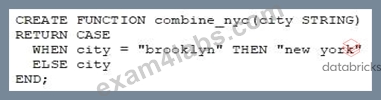
A data engineer needs to apply custom logic to string column city in table stores for a specific use case. In order to apply this custom logic at scale, the data engineer wants to create a SQL user-defined function (UDF).
Which of the following code blocks creates this SQL UDF?
- A.
- B.
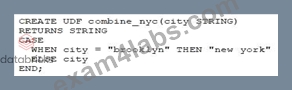
- C.

- D.
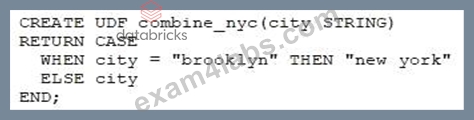
- E.

Answer: E
Explanation:
Explanation
https://www.databricks.com/blog/2021/10/20/introducing-sql-user-defined-functions.html
NEW QUESTION # 74
Which of the following approaches should be used to send the Databricks Job owner an email in the case that the Job fails?
- A. MLflow Model Registry Webhooks
- B. Setting up an Alert in the Job page
- C. There is no way to notify the Job owner in the case of Job failure
- D. Setting up an Alert in the Notebook
- E. Manually programming in an alert system in each cell of the Notebook
Answer: B
Explanation:
Explanation
https://docs.databricks.com/en/workflows/jobs/job-notifications.html
NEW QUESTION # 75
Which of the following describes the relationship between Bronze tables and raw data?
- A. Bronze tables contain raw data with a schema applied.
- B. Bronze tables contain less data than raw data files.
- C. Bronze tables contain aggregates while raw data is unaggregated.
- D. Bronze tables contain more truthful data than raw data.
- E. Bronze tables contain a less refined view of data than raw data.
Answer: A
Explanation:
Explanation
The Bronze layer is where we land all the data from external source systems. The table structures in this layer correspond to the source system table structures "as-is," along with any additional metadata columns that capture the load date/time, process ID, etc. The focus in this layer is quick Change Data Capture and the ability to provide an historical archive of source (cold storage), data lineage, auditability, reprocessing if needed without rereading the data from the source system.https://www.databricks.com/glossary/medallion-architecture#:~:text=Bronze%20layer%20%28raw%20d
NEW QUESTION # 76
......
Latest Databricks-Certified-Data-Engineer-Associate Exam Dumps Databricks Exam from Training: https://www.exam4labs.com/Databricks-Certified-Data-Engineer-Associate-practice-torrent.html
Pass Databricks Databricks-Certified-Data-Engineer-Associate PDF Dumps Recently Updated 102 Questions: https://drive.google.com/open?id=14A9n7m_bs8-nlydzif33Te9FFbr8FraP