

Practice NSE 7 Network Security Architect NSE7_LED-7.0 exam. Online Exam Practice Tests with detailed explanations! Pass NSE7_LED-7.0 with confidence!
NSE7_LED-7.0 - Fortinet NSE 7 - LAN Edge 7.0 Practice Tests 2023 | Exam4Labs
NEW QUESTION # 19
Which two statements about MAC address quarantine by redirect mode are true? (Choose two)
- A. It is the default mode for MAC address quarantine
- B. The quarantined device is moved to the quarantine VLAN
- C. The device MACaddress is added to the Quarantined Devices firewall address group
- D. The quarantined device is kept in the current VLAN
Answer: C,D
Explanation:
Explanation
According to the FortiGate Administration Guide, "MAC address quarantine by redirect mode allows you to quarantine devices by adding their MAC addresses to a firewall address group called Quarantined Devices.
The quarantined devices are kept in their current VLANs, but their traffic is redirected to a quarantine portal." Therefore, options B and D are true because they describe the statements about MAC address quarantine by redirect mode. Option A is false because the quarantined device is not moved to the quarantine VLAN, but rather kept in the current VLAN. Option C is false because redirect mode is not the default mode for MAC address quarantine, but rather an alternative mode that can be enabled by setting mac-quarantine-mode to redirect.
https://docs.fortinet.com/document/fortiap/7.0.0/configuration-guide/734537/radius-authenticated-dynamic-vlan-: https://docs.fortinet.com/document/fortigate/7.0.0/administration-guide/734537/mac-address-quarantine
NEW QUESTION # 20
What is the purpose of enabling Windows Active Directory Domain Authentication on FortiAuthenticator?
- A. It enables FortiAuthenticator to import users from Windows AD
- B. It enables FortiAuthenticator to use a Windows CA certificate when authenticating RADIUS users
- C. It enables FortiAuthenticator to use Windows administrator credentials to perform an LDAP lookup for a user search
- D. It enables FortiAuthenticator to register itself as a Windows trusted device to proxy authentication using Kerberos
Answer: D
Explanation:
Explanation
According to the FortiAuthenticator Administration Guide2, "Windows Active Directory domain authentication enables FortiAuthenticator to join a Windows Active Directory domain as a machine entity and proxy authentication requests using Kerberos." Therefore, option D is true because it describes the purpose of enabling Windows Active Directory domain authentication on FortiAuthenticator. Option A is false because FortiAuthenticator does not need Windows administrator credentials to perform an LDAP lookup for a user search. Option B is false because FortiAuthenticator does not use a Windows CA certificate when authenticating RADIUS users, but rather its own CA certificate. Option C is false because FortiAuthenticator does not import users from Windows AD, but rather synchronizes them using LDAP or FSSO.
NEW QUESTION # 21
Which two pieces of information can the diagnose test authserver ldap command provide? (Choose two.)
- A. It displays the LDAP groups found for the user
- B. It displays the LDAP codes returned by the LDAP server
- C. It displays whether the user credentials are correct
- D. It displays whether the admin bind user credentials are correct
Answer: B,C
Explanation:
Explanation
According to the FortiGate CLI Reference Guide, "The diagnose test authserver ldap command tests LDAP authentication with a specific LDAP server. The command displays whether the user credentials are correct and whether the user belongs to any groups that match a firewall policy. The command also displays the LDAP codes returned by the LDAP server." Therefore, options B and C are true because they describe the information that the diagnose test authserver ldap command can provide. Option A is false because the command does not display whether the admin bind user credentials are correct, but rather whether the user credentials are correct. Option D is false because the command does not display the LDAP groups found for the user, but rather whether the user belongs to any groups that match a firewall policy.
NEW QUESTION # 22
You are configuring a FortiGate wireless network to support automated wireless client quarantine using IOC Which two configurations must you put in place for a wireless client to be quarantined successfully? (Choose two)
- A. Configure a firewall policy to allow communication
- B. Configure the wireless network to be in tunnel mode
- C. Configure the FortiGate device in the Security Fabric with a FortiAnalyzer device
- D. Configure the wireless network to be in bridge mode
Answer: B,C
Explanation:
Explanation
According to the FortiGate Administration Guide, "To enable automated wireless client quarantine using IOC, you must configure the following settings: Configure your wireless network to be in tunnel mode. This allows FortiGate to inspect all wireless traffic and applysecurity policies. Configure your FortiGate device in the Security Fabric with a FortiAnalyzer device. This allows FortiAnalyzer to detect indicators of compromise (IOC) from wireless traffic and send quarantine commands to FortiGate." Therefore, options A and B are true because they describe the configurations that must be put in place for a wireless client to be quarantined successfully using IOC. Option C is false because configuring a firewall policy to allow communication is not required, as the default firewall policy for tunnel mode wireless networks is to allow all traffic. Option D is false because configuring the wireless network to be in bridge mode is not supported, as FortiGate cannot inspect or quarantine wireless traffic in bridge mode.
NEW QUESTION # 23
Refer to the exhibit
A device connected to port2 on FortiSwitch cannot access the network The port is assigned a security policy to enforce 802 1X authentication While troubleshooting the issue, the administrator obtains the debug output shown in the exhibit Which two scenarios are likely to cause this issue? (Choose two.)
- A. The device has been quarantined for 3600 seconds.
- B. The device is not configured for 802 IX authentication.
- C. The device has been assigned the guest VLAN
- D. The device does not support 802 1X authentication
Answer: B,D
Explanation:
Explanation
According to the exhibit, the debug output shows that the device connected to port2 on FortiSwitch is sending an EAPOL-Start message, which is the first step of the 802.1X authentication process. However, the output also shows that the device is not sending any EAP-Response messages, which are required to complete the authentication process. Therefore, option A is true because the device is not configured for 802.1X authentication, which means that it does not have the correct credentials or settings to authenticate with the RADIUS server. Option D is also true because the device does not support 802.1X authentication, which means that it does not have the capability or software to perform 802.1X authentication. Option B is false because the device has not been quarantined for 3600 seconds, but rather has a session timeout of 3600 seconds, which is the default value for 802.1X sessions. Option C is false because the device has not been assigned the guest VLAN, but rather has been assigned the default VLAN, which is VLAN 1.
NEW QUESTION # 24
Refer to the exhibit.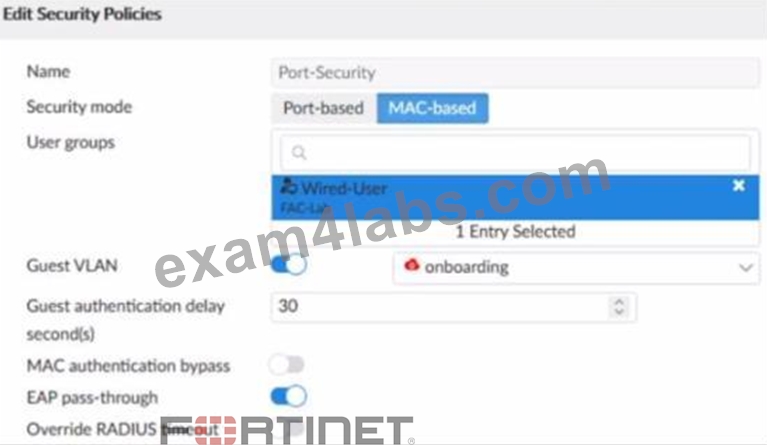
Examine the FortiSwitch security policy shown in the exhibit
If the security profile shown in the exhibit is assigned to all ports on a FortiSwitch device for 802 1X authentication which statement about the switch is correct?
- A. FortiSwitch will try to authenticate non-802 1X devices using the device MAC address as the username and password
- B. FortiSwitch will assign non-802 1X devices to the onboarding VLAN
- C. FortiSwitch cannot authenticate multiple devices connected to the same port
- D. All EAP messages will be terminated on FortiSwitch
Answer: B
Explanation:
Explanation
According to the FortiSwitch Administration Guide, "If a device does not support 802.1X authentication, you can configure the switch to assign the device to an onboarding VLAN. The onboarding VLAN is a separate VLAN that you can use to provide limited network access to non-802.1X devices." Therefore, option C is true because it describes the behavior of FortiSwitch when the security profile shown in the exhibit is assigned to all ports. Option A is false because FortiSwitch can authenticate multiple devices connected to the same port using MAC-based or MAB-EAP modes. Option B is false because FortiSwitch will not try to authenticate non-802.1X devices using the device MAC address as the username and password, but rather use MAC authentication bypass (MAB) or EAP pass-through modes. Option D is false because all EAP messages will be terminated on FortiGate, not FortiSwitch, when using 802.1X authentication.
NEW QUESTION # 25
Refer to the exhibits
The exhibits show the wireless network (VAP) SSID profiles defined on FortiManager and an AP profile assigned to a group of APs that are supported by FortiGate None of the APs are broadcasting the SSlDs defined by the AP profile Which changes do you need to make to enable the SSIDs to broadcast?
- A. In the SSIDs section enable Manual and assign the networks manually
- B. In the SSIDs section enable Tunnel
- C. Enable one channel in the Channels section
- D. Enable multiple channels in the Channels section and enable Radio Resource Provision
Answer: C
Explanation:
Explanation
According to the FortiManager Administration Guide1, "To enable the SSID, you must select at least one channel for the radio. If no channels are selected, the SSID will not be enabled." Therefore, enabling one channel in the Channels section will allow the SSIDs to broadcast.
NEW QUESTION # 26
Refer to the exhibit
Examine the sections of the configuration shown in the output
What action will FortiGate take when verifying the student certificate through OCSP?
- A. Consider the student certificate status as valid if the OCSP server is unreachable
- B. Use the OCSP URL included in the student certificate to verify the student certificate
- C. Reject the student certificate if the OCSP server replies that the student certificate status is unknown
- D. Not verify the OCSP server certificate
Answer: B
Explanation:
Explanation
According to the exhibit, the FortiGate configuration has ocsp-status enabled and ocsp-option set to certificate.
This means that FortiGate will use OCSP to verify the revocation status of certificates presented by clients. According to the FortiGate Administration Guide2, "If you select certificate, FortiGate uses an OCSP URL included in a certificate to verify that certificate." Therefore, option C is true because it describes what action FortiGate will take when verifying the student certificate through OCSP. Option A is false because FortiGate will not reject the student certificate if the OCSP server replies that the student certificate status is unknown, but rather accept it as valid. Option B is false because FortiGate will verify the OCSPserver certificate by default, unless strict-ocsp-check is disabled. Option D is false because FortiGate will not consider the student certificate status as valid if the OCSP server is unreachable, but rather reject it as invalid.
NEW QUESTION # 27
Refer to the exhibit.
Examine the debug output shown in the exhibit
Which two statements about the RADIUS debug output are true'' (Choose two)
- A. User authentication succeeded using MSCHAP
- B. The user student belongs to the SSLVPN group
- C. User authentication failed
- D. The RADIUS server sent a vendor-specific attribute in the RADIUS response
Answer: A,B
Explanation:
Explanation
According to the exhibit, the debug output shows a RADIUS debug output from FortiGate. The output shows that FortiGate sent a RADIUS Access-Request packet to FortiAuthenticator with the username student and received a RADIUS Access-Accept packet from FortiAuthenticator with a Class attribute containing SSLVPN.
Therefore, option A is true because it indicates that the user student belongs to the SSLVPN group on FortiAuthenticator. The output also shows that FortiGate used MSCHAP as the authentication method and received a MS-MPPE-Send-Key and a MS-MPPE-Recv-Key from FortiAuthenticator. Therefore, option D is true because it indicates that user authentication succeeded using MSCHAP. Option B is false because user authentication did not fail, but rather succeeded. Option C is false because FortiAuthenticator did not send a vendor-specific attribute in the RADIUS response, but rather standard attributes defined by RFCs.
NEW QUESTION # 28
Refer to the exhibit.
Examine the network diagram and packet capture shown in the exhibit
The packet capture was taken between FortiGate and FortiAuthenticator and shows a RADIUS Access-Request packet sent by FortiSwitch to FortiAuthenticator through FortiGate Why does the User-Name attribute in the RADIUS Access-Request packet contain the client MAC address?
- A. The client is performing user authentication
- B. FortiSwitch is sending a RADIUS accounting message to FortiAuthenticator
- C. FortiSwitch is authenticating the client using MAC authentication bypass
- D. The client is performing AD machine authentication
Answer: C
Explanation:
Explanation
According to the exhibit, the User-Name attribute in the RADIUS Access-Request packet contains the client MAC address of 00:0c:29:6a:2b:3d. This indicates that FortiSwitch is authenticating the client using MAC authentication bypass (MAB), which is a method of authenticating devices that do not support 802.1X by using their MAC address as the username and password. Therefore, option B is true because it explains why the User-Name attribute contains the client MAC address. Option A is false because AD machine authentication uses a computer account name and password, not a MAC address. Option C is false because user authentication uses a user name and password, not a MAC address. Option D is false because FortiSwitch is sending a RADIUS Access-Request message to FortiAuthenticator, not a RADIUS accounting message.
NEW QUESTION # 29
An administrator is testing the connectivity for a new VLAN The devices in the VLAN are connected to a FortiSwitch device that is managed by FortiGate Quarantine is disabled on FortiGate While testing the administrator noticed that devices can ping FortiGate and FortiGate can ping the devices The administrator also noticed that inter-VLAN communication works However intra-VLAN communication does not work Which scenario is likely to cause this issue?
- A. The native VLAN configured on the ports is incorrect
- B. The FortiSwitch MAC address table is missing entries
- C. The FortiGate ARP table is missing entries
- D. Access VLAN is enabled on the VLAN
Answer: B
Explanation:
Explanation
According to the scenario, the devices in the VLAN are connected to a FortiSwitch device that is managed by FortiGate. Quarantine is disabled on FortiGate, which means that the devices are not blocked by any security policy. The devices can ping FortiGate and FortiGate can ping the devices, which means that the IP connectivity is working. Inter-VLAN communication works, which means that the routing between VLANs is working. However, intra-VLAN communication does not work, which means that the switching within the VLAN is not working. Therefore, option C is true because the FortiSwitch MAC address table is missing entries, which means that the FortiSwitch does not know how to forward frames to the destination MAC addresses within the VLAN. Option A is false because access VLAN is enabled on the VLAN, which means that the VLAN ID is added to the frames on ingress and removed on egress. This does not affect intra-VLAN communication. Option B is false because the native VLAN configured on the ports is incorrect, which means that the frames on the native VLAN are not tagged with a VLAN ID. This does not affect intra-VLAN communication. Option D is false because the FortiGate ARP table is missing entries, which means that FortiGate does not know how to map IP addresses to MAC addresses. This does not affect intra-VLAN communication.
NEW QUESTION # 30
When you configure a FortiAP wireless interface for auto TX power control which statement describes how it configures its transmission power"?
- A. Every 30 seconds FortiGate measures the signal strength of the weakest associated client The AP will then configure its radio power to match the detected signal strength of the client
- B. Every 30 seconds FortiGate measures the signal strength of adjacent FortiAP interfaces It will adjust the adjacent AP power to be detectable at -70 dBm
- C. Every 30 seconds the AP will measure the signal strength of the AP using the client The AP will adjust its signal strength up or down until the AP signal is detected at -70 dBm
- D. Every 30 seconds FortiGate measures the signal strength of adjacent AP interfaces It will adjust its own AP power to match the adjacent AP signal strength
Answer: C
Explanation:
Explanation
According to the FortiAP Configuration Guide1, "Auto TX power control allows the AP to adjust its transmit power based on the signal strength of the client. The AP will measure the signal strength of the client every 30 seconds and adjust its transmit power up or down until the client signal is detected at -70 dBm." Therefore, option A is true because it describes how the FortiAP wireless interface configures its transmission power when auto TX power control is enabled. Option B is false because FortiGate does not measure the signal strength of adjacent AP interfaces, but rather the FortiAP does. Option C is false because FortiGate does not adjust the adjacent AP power, but rather the FortiAP adjusts its own power. Option D is false becauseFortiGate does not measure the signal strength of the weakest associated client, but rather the FortiAP does.
NEW QUESTION # 31
Refer to the exhibit
Examine the FortiGate RSSO configuration shown in the exhibit
FortiGate is configured to receive RADIUS accounting messages on port3 to authenticate RSSO users The users are located behind port3 and the internet link is connected to port1 FortiGate is processing incoming RADIUS accounting messages successfully and RSSO users are getting associated with the RSSO Group user group However all the users are able to access the internet, and the administrator wants to restrict internet access to RSSO users only Which configuration change should the administrator make to fix the problem?
- A. Change the RADIUS Attribute Value selling to match the name of the RADIUS attribute containing the group membership information of the RSSO users
- B. Enable Security Fabric Connection on port3
- C. Add RSSO Group to the firewall policy
- D. Create a second firewall policy from port3 lo port1 and select the target destination subnets
Answer: C
Explanation:
Explanation
According to the exhibit, the firewall policy from port3 to port1 has no user group specified, which means that it allows all users to access the internet. Therefore, option B is true because adding RSSO Group to the firewall policy will restrict internet access to RSSO users only. Option A is false because changing the RADIUS Attribute Value setting will not affect the firewall policy, but rather the RSSO user group membership. Option C is false because enabling Security Fabric Connection on port3 will not affect the firewall policy, but rather the communication between FortiGate and other Security Fabric devices. Option D is false because creating a second firewall policy from port3 to port1 will not affect the existing firewall policy, but rather create a redundant or conflicting policy.
NEW QUESTION # 32
You are setting up an SSID (VAP) to perform RADlUS-authenticated dynamic VLAN allocation Which three RADIUS attributes must be supplied by the RADIUS server to enable successful VLAN allocation'' (Choose three.)
- A. Tunnel-Medium-Type
- B. Tunnel-Type
- C. Tunnel-Pvt-Group-ID
- D. Tunnel-Preference
- E. Tunnel-Private-Group-ID
Answer: A,B,E
Explanation:
Explanation
According to the FortiAP Configuration Guide, "To perform RADIUS-authenticated dynamic VLAN allocation, the RADIUS server must supply the following RADIUS attributes: Tunnel-Private-Group-ID, which specifies the VLAN ID to assign to the user. Tunnel-Type, which specifies the tunneling protocol used for the VLAN. The value must be 13 (VLAN). Tunnel-Medium-Type, which specifies the transport medium used for the VLAN. The value must be 6 (802). Therefore, options A, D, and E are true because they describe the RADIUS attributes that must be supplied by the RADIUS server to enable successful VLAN allocation.
Option B is false because Tunnel-Pvt-Group-ID is not a valid RADIUS attribute name, but rather a typo for Tunnel-Private-Group-ID. Option C is false because Tunnel-Preference is not a required RADIUS attribute for dynamic VLAN allocation, but rather an optional attribute that specifies the priority of the VLAN.
NEW QUESTION # 33
Refer to the exhibit.
Examine the LDAP server configuration shown in the exhibit Note that the Username setting has been expanded to display Its full content On the Windows AD server 10.0.1.10, the administrator used dsquery. which returned the following output:
According to the output which FortiGate LDAP setting is configured incorrectly''
- A. Username
- B. Common Name Identifier
- C. Bind Type
- D. Distinguished Name
Answer: D
Explanation:
Explanation
According to the exhibits, the LDAP server configuration on FortiGate has the Distinguished Name set to
"dc=training,dc=lab". However, according to the output of the dsquery command on the Windows AD server, the Distinguished Name of the domain should be "dc=trainingAD,dc=training,dc=lab". Therefore, option C is true because the Distinguished Name on FortiGate is configured incorrectly and does not match the actual Distinguished Name of the domain. Option A is false because the Common Name Identifier on FortiGate is configured correctly as "cn". Option B is false because the Bind Type on FortiGate is configured correctly as
"Regular". Option D is false because the Username on FortiGate is configured correctly as
"cn=admin,cn=users,dc=trainingAD,dc=training,dc=lab".
NEW QUESTION # 34
An administrator is testing the connectivity for a new VLAN The devices in the VLAN are connected to a FortiSwitch device that is managed by FortiGate Quarantine is disabled on FortiGate While testing the administrator noticed that devices can ping FortiGate and FortiGate can ping the devices The administrator also noticed that inter-VLAN communication works However intra-VLAN communication does not work Which scenario is likely to cause this issue?
- A. The native VLAN configured on the ports is incorrect
- B. The FortiSwitch MAC address table is missing entries
- C. The FortiGate ARP table is missing entries
- D. Access VLAN is enabled on the VLAN
Answer: B
Explanation:
Explanation
According to the scenario, the devices in the VLAN are connected to a FortiSwitch device that is managed by FortiGate. Quarantine is disabled on FortiGate, which means that the devices are not blocked by any security policy. The devices can ping FortiGate and FortiGate can ping the devices, which means that the IP connectivity is working. Inter-VLAN communication works, which means that the routing between VLANs is working. However, intra-VLAN communication does not work, which means that the switching within the VLAN is not working. Therefore, option C is true because the FortiSwitch MAC address table is missing entries, which means that the FortiSwitch does not know how to forward frames to the destination MAC addresses within the VLAN. Option A is false because access VLAN is enabled on the VLAN, which means that the VLAN ID is added to the frames on ingress and removed on egress. This does not affect intra-VLAN communication. Option B is false because the native VLAN configured on the ports is incorrect, which means that the frames on the native VLAN are not tagged with a VLAN ID. This does not affect intra-VLAN communication. Option D is false because the FortiGate ARP table is missing entries, which means that FortiGate does not know how to map IP addresses to MAC addresses. This does not affect intra-VLAN communication.
NEW QUESTION # 35
......
Get instant access to NSE7_LED-7.0 practice exam questions: https://drive.google.com/open?id=16bZ_zVvMKw2Vqz6OycymiSg36v6nkquH
The best NSE7_LED-7.0 exam study material and preparation tool is here: https://www.exam4labs.com/NSE7_LED-7.0-practice-torrent.html