

[Aug-2021] Pass Adobe AD0-E117 Exam in First Attempt Guaranteed!
Full AD0-E117 Practice Test and 52 unique questions with explanations waiting just for you, get it now!
NEW QUESTION 31
During an optimization session, a client using AEM 6.5 mentions that they face challenges with their AEM Author setup. The client has significant repository growth and can see an increased amount of TAR files in the segmentstore on disk. When editors are working, they see that workflows take up more time. The purging of workflows works as expected. Which two optimizations should an Architect suggest to took into and further investigate? (Choose two.)
- A. Leverage workflow offloading for all workflows
- B. Increase the maxFileSize of the TAR segmentstore
- C. Execute an offline tar compaction twice a day
- D. Leverage Transient Workflows where possible
- E. Configure the Maximum Parallel Jobs
Answer: D,E
NEW QUESTION 32
A client using AEM 6.5 on-premise is experiencing an unsustainable repository growth of 100Gb a day. After investigation, an Architect finds out that the DAM is causing this issue. Each image uploaded to the DAM triggers the creation of approximately 100 renditions, necessary by business to consume in different channels and systems. The client also complains about stale content reported by site visitors happening randomly in pages where article-related components are present.
How should the Architect address these issues?
- A. Leverage AEM Adaptive Image Servlet cache image variations in Dispatcher, and implement a cache TTL in Dispatcher
- B. Split WCM and DAM in separate instances, set up Connected Assets, and re-implement article-related components to use AJAX to load the content
- C. Split WCM and DAM in separate instances, set up Connected Assets, and implement a workflow to purge all pages affected by an article change in Dispatcher
- D. Leverage AEM Adaptive Image Servlet, cache image variations in Dispatcher, and reimplement article-related components to use AJAX to load the content
Answer: B
NEW QUESTION 33
A customer has an international presence and a strong brand image. The customer considers the exceptional quality images used for both print and on the website to be essential for its business, The customer uses AEM
6.5 managed services with a configuration of 2 dispatchers, 2 publishers, and 1 author.
The original images can weigh up to 500Mb with videos weighing even more. Renditions are generated after files are uploaded to AEM DAM by the Design team so the Authoring team can use them on the website.
The teams report issues with platform stability and slowness. Visitors report that images look pixelated on some screens and pages are very slow to load.
Which two actions should the Architect take to resolve these issues? (Choose two.)
- A. Split AEM Assets and Sites in two different stacks and use Connected Assets
- B. Allocate more memory to ImageMagick and FFmpeg
- C. Optimize renditions for the different viewports used by the visitors
- D. Add more dispatchers and publishers to the AEM configuration
- E. Train the design team to upload smaller assets and save the originals elsewhere
Answer: A,E
NEW QUESTION 34
A client's site does not show the latest page content for some site visitors. The client has two data centers with each configured with a Dispatcher connected to two Publish machines. The site load issue only occurs intermittently for visitors from one of the data centers.
Which step should the Architect take to resolve the issue?
- A. Review the log files on the Author instances to determine if there are any template errors
- B. Check the SSL certificate on the impacted data center's load balance.
- C. Disable caching on all impacted data centers Dispatchers to force the Publish machines to serve the page content
- D. Check the Publish instance(s) attached to the Dispatcher associated to the impacted data center
Answer: B
NEW QUESTION 35
A new AEM Sites implementation includes a component that lists the 10 most recently published PDF documents in AEM Assets. The component works as expected during development and passes QA testing. The business starts to use it while entering content and uploading assets in preparation for go-live. A few days later, the component's PDF list is empty.
What is the most likely cause of the issue?
- A. A PDF with incorrect MIME type has been uploaded.
- B. The component is missing a matching Oak index.
- C. The component is missing the HTL display context to escape the PDF title.
- D. A PDF with too large file size has been uploaded.
Answer: D
NEW QUESTION 36
AEM Site users report that the web content pages render very slowly. An Architect notices that the CPU usages of the AEM Publish instances are spiking and reviews the following entry in the log:
[Frt Nov 27 23:11:00 2019] [I] [pid 16004 (tid 140134145820416)] Current cache hit ratio: 47.94 % What should the Architect do to increase the dispatcher cache ratio and prevent the AEM Publish CPU usage spikes?
- A. Add additional dispatcher servers
- B. Review and optimize the Dispatcher cache configuration
- C. Add additional AEM instances to the Publish Farm
- D. Create a cron job that will delete the dispatcher cache on a regular basis
Answer: D
NEW QUESTION 37
AEM as a cloud service introduces major changes in the architecture by using containers. Which key architectural change was necessary to allow this to occur?
- A. Using sling content distribution as the replication mechanism
- B. Using MongoDB for Author environment
- C. Using Adobe 10 for asset ingestion and processing, storing it on a separate blob and providing AEM with metadata
- D. Isolating /app and /libs from the content, configurations and state mgmt.
Answer: D
NEW QUESTION 38
A client is migrating the content from a legacy website to an existing AEM implementation. An Architect evaluates the content of the legacy site and determine-that there are approximately 20.000 pages with a common structure, and a few hundred pages that do not follow a pattern. The client wants to complete the migration as soon as possible.
Which approach should the Architect recommend for the content migration?
- A. Use Site importer to import the content into AEM
- B. Migrate all common pages using the ETL procedure with multiple rounds
- C. Recreate the entire content manually with a group of Content Authors
- D. Migrate all common pages using the ETL procedure and use manual authoring for the rest
Answer: C
NEW QUESTION 39
A customer has a requirement to allow authors to access AEM with single sign-on. To achieve this an Architect needs to integrate AEM with the customer's identity management system.
Which two actions could an Architect take to meet this requirement? (Choose two.)
- A. Configure the generic SSO Authentication Handler
- B. Implement a custom JAAS Login Module
- C. Configure the Sling Authentication Requirements for the OSGi HTTP Service
- D. Implement the generic SSO Authentication Handler interface
- E. Configure the SAML Authentication Handler
Answer: A,D
NEW QUESTION 40
A large digital agency has 10 TB of assets in their DAM where renditions for each Asset must be created without affecting performance for the authors. Which capability should the Architect recommend to meet the requirements?
- A. Use AEM Asset Offloading
- B. Update dispatcher configuration to cache Assetsa
- C. Reduce the number of AEM Asset versions
- D. Create AEM multi-threaded workflow
Answer: D
NEW QUESTION 41
A customer wants to simplify and automate publishing press pages and defines the following flows: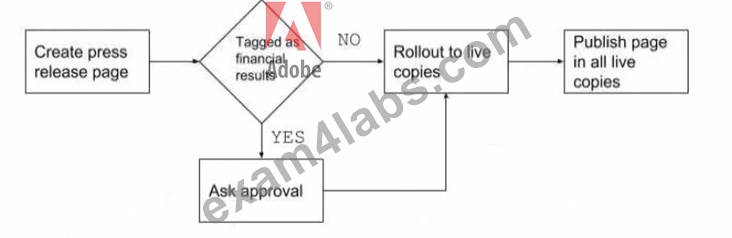
What should the Architect recommend?
- A. Configure MSM with the "Activate on Blueprint activation" option
- B. Advise the customer to use Launches
- C. Create a custom workflow
- D. Implement a Sling event listener that triggers on page creation
Answer: B
NEW QUESTION 42
An enterprise client is on-boarding an AEM Desktop application to provide authors with the ability to load the AEM repository virtually on the file system. The desktop application is unable to connect to the AEM Author, which has SSL enabled. The intermediate certificate is installed on Apache.
How should an Architect resolve this issue?
- A. Install the certificate chain to the keystore of the AEM authentication service user
- B. Install the certificate chain to the AEM truststore
- C. Install the certificate chain to the keystore of the AEM ssl-service user
- D. Install the Root certificate to the AEM truststore
Answer: D
NEW QUESTION 43
A customer has a website with 10,000 pages and wants to improve performance. Which option should be used?
- A. Decrease .stat file level from the default
- B. Advise to use URL parameters instead of sling selectors
- C. Increase .stat file level from the default
- D. Specify a wildcard allow rule in the invalidate section
Answer: B
NEW QUESTION 44
A customer wants to migrate their AEM environment from an on-premise infrastructure to a public cloud to improve performance. The customer currently hosts many assets (images, videos, documents) in the DAM.
Approximately 10 business users frequently upload new assets and update existing assets. Editors then use these assets on the sites.
What should an Architect do as part of this migration?
- A. Run online revision cleanup before moving to the new storage format
- B. Move to a shared datastore and enable binary less replication
- C. Set up Connected Assets to share the DAM assets in the sites
- D. Set up a horizontally scalable AEM environment on MongoDB
Answer: A
NEW QUESTION 45
A financial sector client is using AEM 6.5 on premise. The creative team needs to create the content for the various marketing campaigns that are scheduled. The client wants to use Experience Fragments (XF) to accelerate content creation for marketing purposes.
Which Data flow diagram should an Architect use to communicate requirements to the client network team?
A)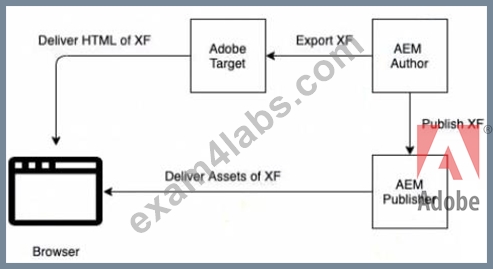
B)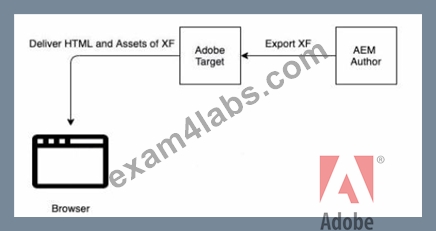
C)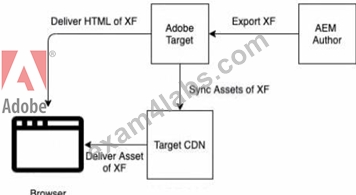
D)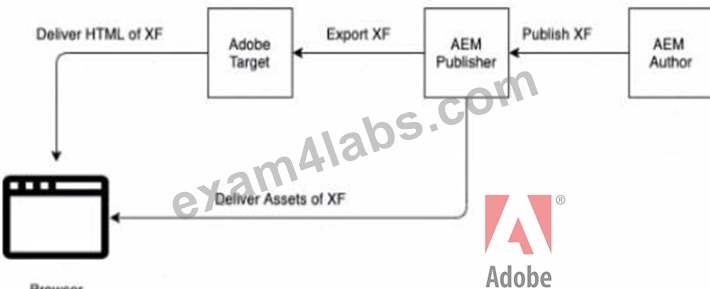
- A. OptionB
- B. OptionA
- C. OptionC
- D. OptionD
Answer: C
NEW QUESTION 46
A company is implementing a new e-commerce site that is expected to get seasonal and flash-sale induced traffic peaks from all over the world. It is projected that a minute of downtime could cause excessive lost revenue. The company management wants to keep resource utilization to optimal levels without experiencing degradation to avoid introducing bugs in the system.
The Architect needs to choose between AEM 6.5 and AEM as Cloud Service.
What are the two most critical non-functional requirements the Architect must consider? (Choose two.)
- A. Maintainability
- B. Scalability
- C. Availability
- D. Reliability
- E. Usability
Answer: B,E
NEW QUESTION 47
A client recently purchased the Smart Content Service and is considering using the Enhanced Smart Tagging feature. As part of the process, the client recently created a new tagging taxonomy that has not been applied to any assets yet. An Architect needs to demonstrate the feature on a subset of the client's assets before using on all assets.
How should the Architect proceed?
- A. Enable Smart Tagging via the folder properties for a single folder of assets
- B. Enable Smart Tagging via the folder properties for a single folder of assets, then run the Smart Tags Training workflow
- C. Add sample assets to a new folder, tag assets in folder, then run the Smart Tags Training workflow
- D. Add sample assets to a new folder, tag assets in folder, then enable Smart Tagging via the folder properties
Answer: B
NEW QUESTION 48
A news agency editor wants to publish news articles to an intermediate Publish (preview) instance for internal review before publishing the article to production Publish instance.
Which two steps should the Architect recommend? (Choose two.)
- A. Create a closed user group (CUG) for editors
- B. Create a separate live copy to preview content
- C. Create a reverse replication agent on preview server
- D. Create a custom publish workflow
- E. Set up a new replication agent for preview server
Answer: B,C
NEW QUESTION 49
An AEM Architect is moving existing content from an on-premise AEM to an AEM Cloud Service instance using the Content Transfer Tool. As part of the initial source preparation, the Architect is going to run the offline compaction on the on-premise AEM.
What other two actions should the Architect do to the on-premise AEM before proceeding with the extraction phase? (Choose two.)
- A. Validate that all replication agents are disabled
- B. Stop all bundles using the AEM Web Console
- C. Verify that wipe mode is enabled
- D. Run datastore consistency check via oak-run
- E. Verify that free disk space is at least 1.5x the JCR size
Answer: C,E
NEW QUESTION 50
An AEM Sites implementation is migrating from on-premise to AEM as a Cloud Service. Previously, the application was deployed in a single package for both code and access policy nodes. After initial deployment and testing in the new infrastructure, it is reported that user permissions are not working as expected.
What change should the Architect make to address this issue?
- A. Update package metadata to use MergePreserve for handling access policy nodes
- B. Refactor access policy nodes to Apache Sling JCR Repoinit scripts in the same package
- C. Move access policy nodes to a dedicated package and install manually
- D. Document permissions and request the Customer Success Engineer to configure
Answer: A
NEW QUESTION 51
......
Prepare for your Adobe certification with the updated Exam4Labs AD0-E117 exam questions: https://drive.google.com/open?id=1k5OpJnSpTT1n05awFCmBxpujdLgHudYv
Get Latest AD0-E117 Dumps Exam Questions in here: https://www.exam4labs.com/AD0-E117-practice-torrent.html