

Updated FCSS_SDW_AR-7.4 Dumps Questions Are Available [2026] For Passing Fortinet Exam
Free UPDATED Fortinet FCSS_SDW_AR-7.4 Certification Exam Dumps is Online
Fortinet FCSS_SDW_AR-7.4 Exam Syllabus Topics:
| Topic | Details |
|---|---|
| Topic 1 |
|
| Topic 2 |
|
| Topic 3 |
|
| Topic 4 |
|
| Topic 5 |
|
NEW QUESTION # 43
Which three characteristics apply to provisioning templates available on FortiManager? (Choose three.)
- A. A CLI template can be of type CLI script or Perl script.
- B. A CLI template group can contain CLI templates of both types.
- C. CLI templates are applied in order, from top to bottom
- D. A template group can include a system template and an SD-WAN template.
- E. Each template group can contain up to three IPsec tunnel templates.
Answer: B,C,D
NEW QUESTION # 44
SD-WAN interacts with many other FortiGate features. Some of them are required to allow SD-WAN to steer the traffic.
Which three configuration elements that you must configure before FortiGate can steer traffic according to SD-WAN rules? (Choose three.)
- A. Interfaces
- B. Traffic shaping
- C. Security profiles
- D. Routing
- E. Firewall policies
Answer: A,D,E
Explanation:
Before FortiGate can steer traffic according to SD-WAN rules, certain configuration elements must be present. The guide states:
"SD-WAN is not a standalone feature and interacts with several fundamental FortiGate configurations.
Specifically, you must: (1) Define the interfaces (physical, VLAN, or IPsec) that will act as SD-WAN members, (2) Create firewall policies to allow traffic to be steered by SD-WAN, and (3) Set up routing so that traffic has valid routes via SD-WAN members. Without these, SD-WAN rules will not be able to match or steer any traffic." Security profiles and traffic shaping are not mandatory for basic SD-WAN steering but can be layered on for enhanced security and QoS once foundational elements are present.
References:
[FCSS_SDW_AR-7.4 1-0.docx Q16]
FortiOS 7.4 SD-WAN Concept Guide, "Prerequisite Configuration Elements for SD-WAN Steering
NEW QUESTION # 45
Exhibit.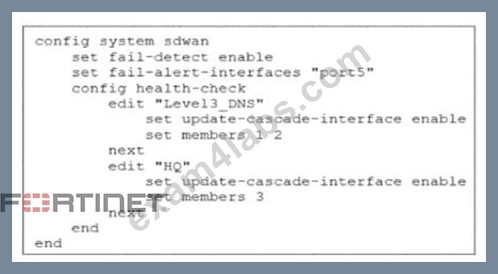
Which action will FortiGate take if it detects SD-WAN members as dead?
- A. FortiGate brings down port5 after it detects all SD-WAN members as dead.
- B. FortiGate fails over to the secondary device after it detects port5 as dead.
- C. FortiGate sends alert messages through poft5 when it detects all SD-WAN members as dead
- D. FoftiGate bounces port5 after it detects all SD-WAN members as dead.
Answer: C
NEW QUESTION # 46
Refer to the exhibits.
You use FortiManager to configure SD-WAN on three branch devices.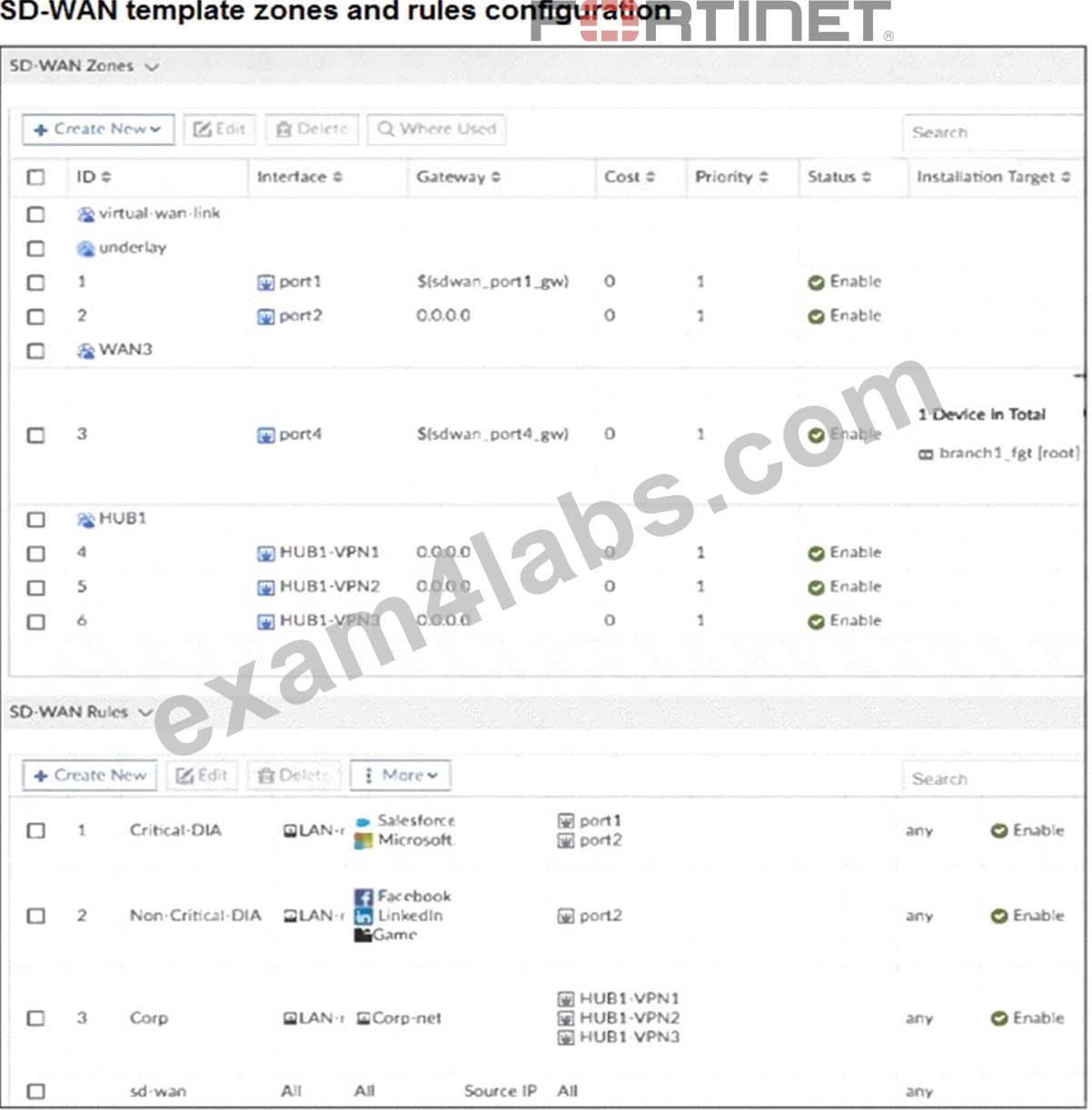
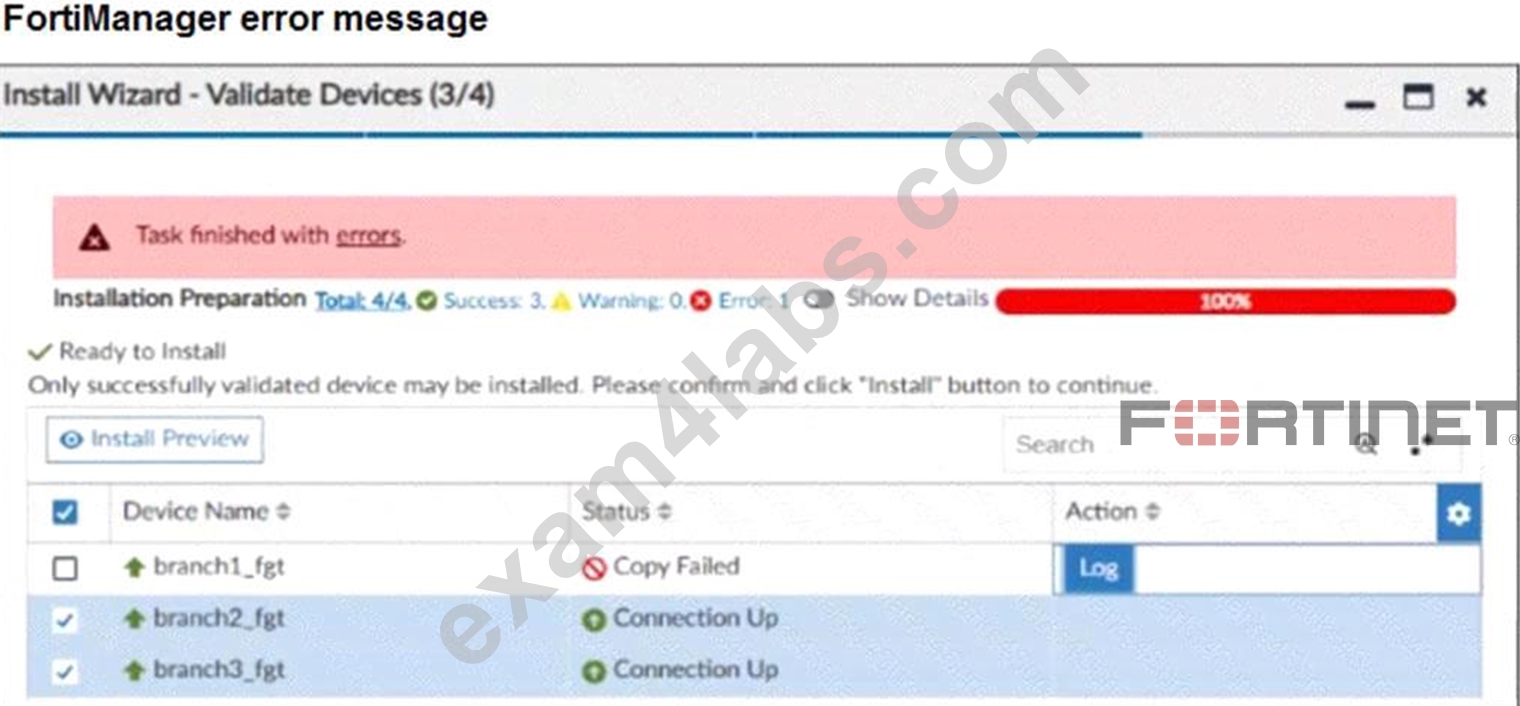
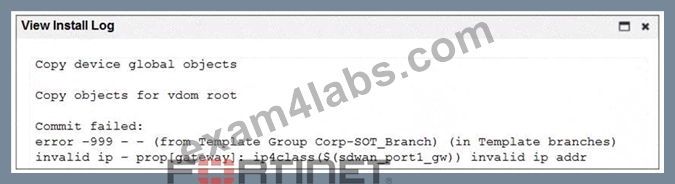
When you install the device settings, FortiManager prompts you with the error "Copy Failed" for the device branch1_fgt. When you click the log button, FortiManager displays the message shown in the exhibit.
There are two different ways to resolve this issue. Based on the exhibits, which methods could you use?
(Choose two.)
- A. Update the management IP address of branch1_fgt.
- B. Specify the gateway of the SD-WAN member port1 with an IP address or use the default value.
- C. Do not define installation targets for SD-WAN members.
- D. Review the per-device mapping configuration for metadata variables
Answer: B,D
Explanation:
Specify the gateway of the SD-WAN member port1 with an IP address or use the default value # The error log shows invalid ip - prop[gateway]: ip4class(${sdwan_port1_gw}) invalid ip addr, meaning the variable
${sdwan_port1_gw} does not have a valid mapping. Assigning a valid IP address or default value for the gateway resolves this error.
Review the per-device mapping configuration for metadata variables # The issue is tied to how the metadata variable ${sdwan_port1_gw} is mapped for branch1_fgt. If this device does not have the variable properly defined in per-device mapping, the configuration will fail. Correcting the mapping ensures that the install works.
NEW QUESTION # 47
An administrator is configuring SD-WAN to load balance their network traffic. Which two things should they consider when setting up SD-WAN? (Choose two.)
- A. You can select the outbandwidth hash mode with all strategies that allow load balancing.
- B. Only the manual and best-quality strategies allow SD-WAN load balancing.
- C. SD-WAN load balancing is possible only using the best quality and lowest cost (SLA) strategies.
- D. When applicable. FortiGate load balances the traffic through all members that meet the SLA target.
Answer: A,C
NEW QUESTION # 48
Refer to the exhibit. The exhibit shows the health-check configuration on a FortiGate device used as a spoke. You notice that the hub FortiGate doesn't prioritize the traffic as expected.
Which two configuration elements should you check on the hub? (Choose two.)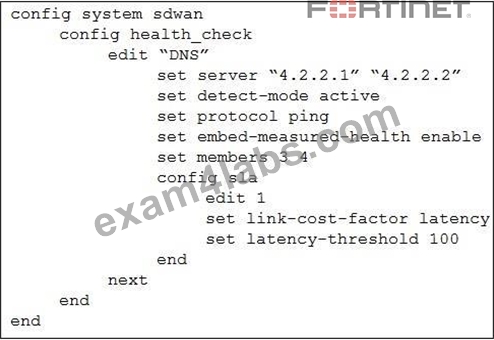
- A. This performance SLA uses the same members.
- B. The performance SLA uses the same criteria.
- C. The performance SLA has the parameter priority-out-slaconfigured.
- D. The performance SLA is configured with set embedded-measure accept.
Answer: B,D
Explanation:
The hub must use a performance SLA with the same criteria as the spoke's health check. The spoke's health check is using ping (protocol ping) and measuring latency (link-cost-factor latency). For the hub to use the data sent by the spoke, its performance SLA must be configured to measure the same metrics. If the hub is looking for jitter or packet loss, it will not use the latency data sent by the spoke.
When a spoke sends embedded health data, the hub FortiGate must be configured to receive and use it. This is done by setting set embedded-measure accept within the performance SLA configuration on the hub. This setting explicitly tells the hub to trust and use the performance metrics received from the remote FortiGate (the spoke). Without this setting, the hub will likely ignore the embedded health data and rely on its own health checks, which could lead to incorrect traffic prioritization.
NEW QUESTION # 49
Exhibit.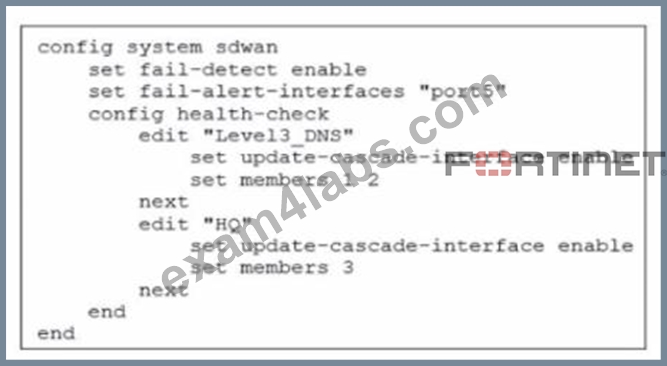
Which action will FortiGate take if it detects SD-WAN members as dead?
- A. FortiGate fails over to the secondary device after it detects port5 as dead.
- B. FortiGate brings down port5 after it detects all SD-WAN members as dead.
- C. FortiGate sends alert messages through poft5 when it detects all SD-WAN members as dead
- D. FoftiGate bounces port5 after it detects all SD-WAN members as dead.
Answer: B
NEW QUESTION # 50
Exhibit.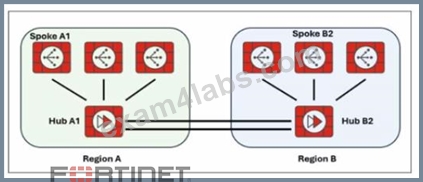
Two hub-and-spoke groups are connected through redundant site-to-site IPsec VPNs between Hub 1 and Hub 2 Which two configuration settings are required for the spoke A1 to establish an ADVPN shortcut with the spoke B2? (Choose two.)
- A. On hubs, auto-discovery-forwarder must be enabled on the IPsec VPNs to spokes.
- B. On hubs, auto-discovery-receiver must be enabled on the IPsec VPNs to spokes.
- C. On hubs, auto-diacovery-sender must be enabled on the IPsec VPNs to spokes
- D. On hubs, auto-discovery-forwarder must be enabled on the IPsec VPNs to hubs.
Answer: C,D
NEW QUESTION # 51
Refer to the exhibits.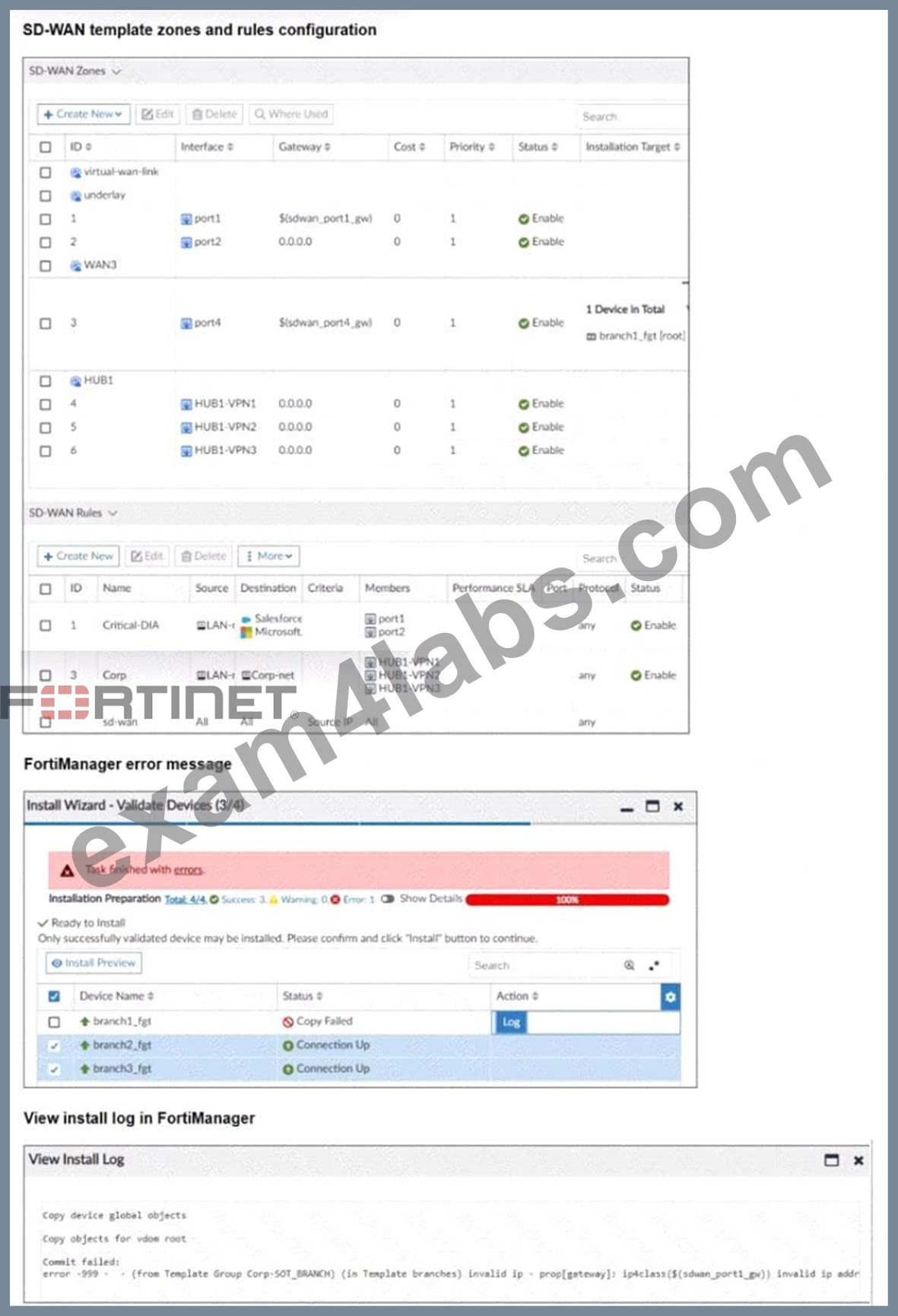
You use FortiManager to configure SD-WAN on three branch devices.
When you install the device settings. FortiManager prompts you with the error "Copy Failed" for the device branch1_fat When you click the log button. FortiManager displays the message shown in the exhibit.
- A. Gateways for all members in a zone must be defined the same way. Specify the gateway of the SD- WAN member port! without metadata variables.
- B. Based on the exhibits, which statement best describes the issue and how you can resolve it?
- C. Check the connection between branch1_fgt and FortiManager
- D. Remove the installation target for the SD-WAN member port4. You cannot combine metadata variable and installation targets.
- E. Check the metadata variable definitions, and review the per-device mapping configuration.
Answer: E
NEW QUESTION # 52
Refer to the exhibits.
Exhibit A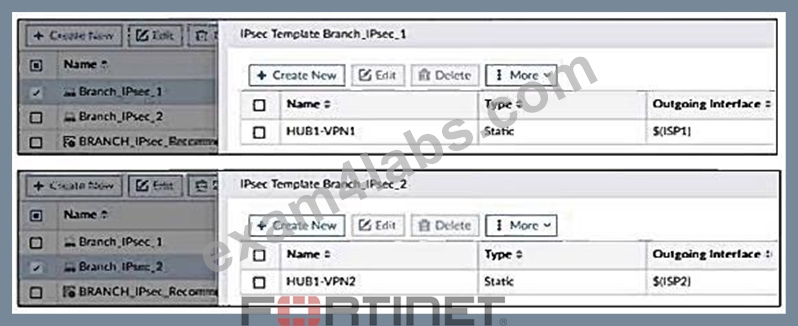
Exhibit B
Exhibit A shows two IPsec templates to define BranchIPsec_1 and Branch_IPsec_2. Each template defines a VPN tunnel.
Exhibit B shows the error message that FortiManager displayed when the administrator tried to assign the second template to the FortiGate device.
Which statement best explain the cause for this issue?
- A. You can assign only one IPsec template to each FortiGate device.
- B. You can assign only one template with a tunnel of type static to each FortiGate device.
- C. You can define only one IPsec tunnel from branch devices to HUB1.
- D. You should review the branch1_fgt configuration for the already configured tunnel with the name HUB1-VPN2.
Answer: A
Explanation:
One Template per FortiGate Device, you have multiple tunnels inside the template.
NEW QUESTION # 53
The FortiGate devices are managed by ForliManager, and are configured for direct internet access (DIA). You confirm that DIA is working as expected for each branch, and check the SD- WAN zone configuration and firewall policies shown in the exhibits.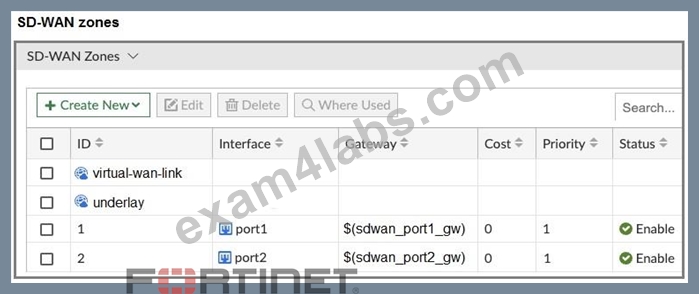

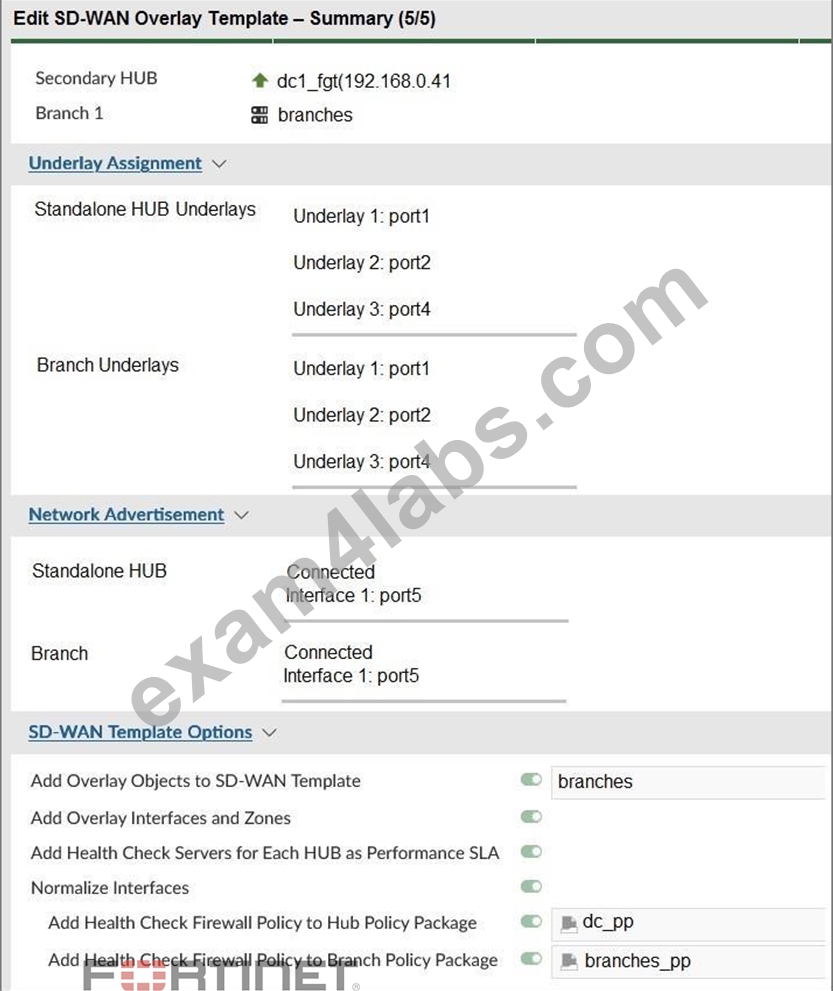
Then, you use the SD-WAN overlay template to configure the IPsec overlay tunnels. You create the associated SD-WAN rules to connect existing branches to the company hub device and apply the changes on the branches.
After those changes, users complain that they lost internet access. DIA is no longer working.
Based on the exhibit, which statement best describes the possible root cause of this issue?
- A. The SD-WAN overlay template didn't configure a firewall policy to allow traffic through the overlay.
- B. The SD-WAN overlay template redefines the interface gateway addresses if they are defined with metadata variables.
- C. The SD-WAN overlay template updates the SD-WAN template and the rules.
- D. The SD-WAN overlay template defines a zone for each underlay interface and moves the interfaces into those zones.
Answer: D
Explanation:
The SD-WAN overlay template defines a zone for each underlay interface and moves the interfaces into those zones. This statement perfectly describes the likely sequence of events. The template, when applied, re-organizes the interfaces and zones, causing the existing firewall policy that relies on the old zone configuration to fail. This is the most plausible root cause.
NEW QUESTION # 54
Which three characteristics apply to provisioning templates available on FortiManager? (Choose three.)
- A. A CLI template can be of type CLI script or Perl script.
- B. A CLI template group can contain CLI templates of both types.
- C. A template group can include a system template and an SD-WAN template.
- D. CLI templates are applied in order, from top to bottom.
- E. Each template group can contain up to three IPsec tunnel templates.
Answer: B,C,D
Explanation:
Template groups can include both system and SD-WAN templates to streamline configuration deployment.
A CLI template group can include both CLI Script and CLI Snippet types.
CLI templates are applied in top-to-bottom order, which affects configuration precedence.
NEW QUESTION # 55
Refer to the exhibit that shows event logs on FortiGate. Based on the output shown in the exhibit, what can you say about the tunnels on this device?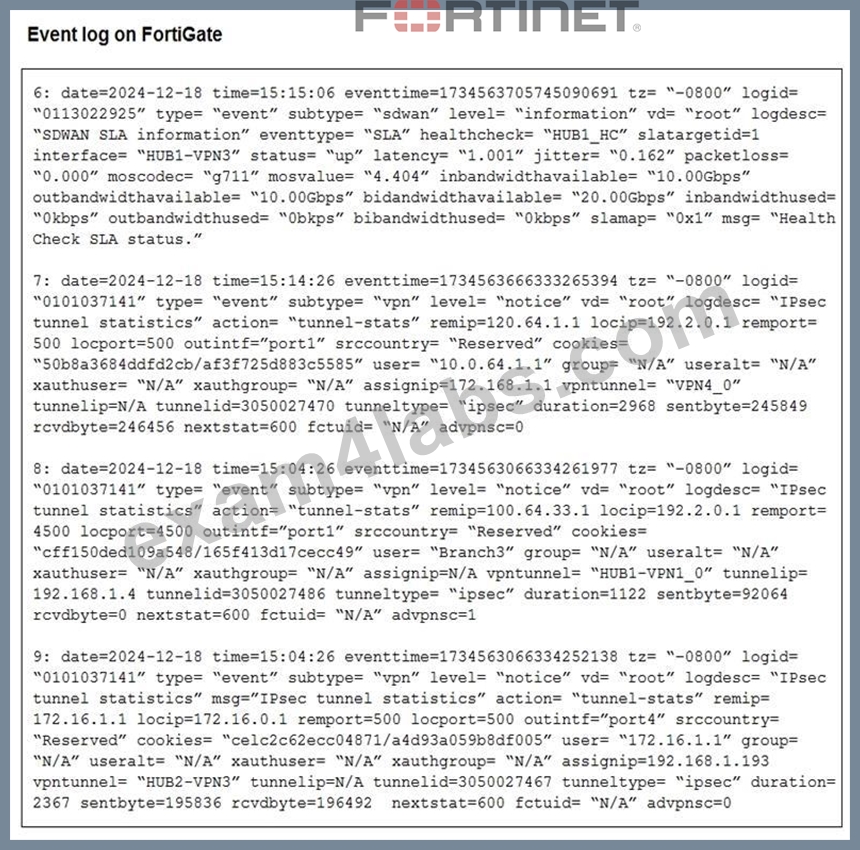
- A. The master tunnel HU82-VPN3 cannot accept ADVPN shortcuts.
- B. There is one shortcut tunnel built from master tunnel VPN4.
- C. The VPN tunnel HUB1-VPN1_0 is a shortcut tunnel.
- D. The device steers voice traffic through the VPN tunnel HUB1-VPN3.
Answer: C
Explanation:
The "advpnsc" log field indicates whether a VPN event is based on an ADVPN shortcut. A value of "1" indicates the tunnel is an ADVPN shortcut, and "0" indicates it is not.
In the event logs, the log entry with "vpntunnel="HUB1-VPN1_0"" shows "advpnsc=1", which signifies that HUB1-VPN1_0 is a shortcut tunnel.
https://docs.fortinet.com/document/fortigate/7.2.0/new-features/661245/add-log-field-to-identify- advpn-shortcuts-in-vpn-logs
NEW QUESTION # 56
Refer to the exhibit. An administrator is troubleshooting SD-WAN on FortiGate. A device behind branch1_fgt generates traffic to the 10.0.0.0/8 network.
The administrator expects the traffic to match SD-WAN rule ID 1 and be routed over HUB1- VPN1.
However, the traffic is routed over HUB1-VPN3.
Based on the output shown in the exhibit, which two reasons, individually or together, could explain the observed behavior? (Choose two.)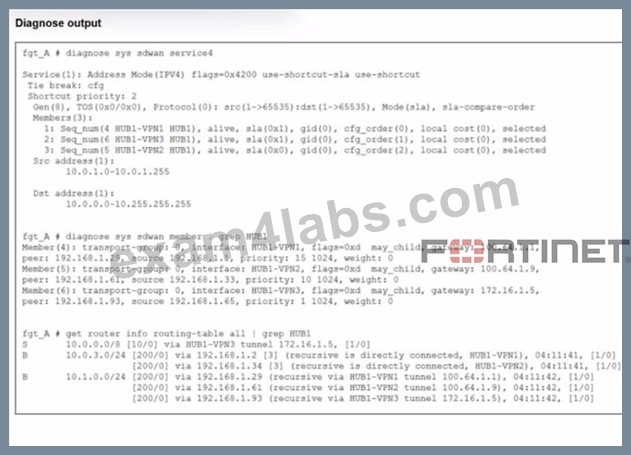
- A. The traffic matches a regular policy route configured with HUB1-VPN3 as the outgoing device
- B. HUB1-VPN3 has a higher member configuration priority than HUB1-VPN1.
- C. HUB1-VPN3 has a lower route priority value (higher priority) than HUB1-VPN1.
- D. HUB1-VPN1 does not have a valid route to the destination
Answer: B,C
NEW QUESTION # 57
In which SD-WAN template field can you use a metadata variable?
- A. Any field identified with an "M" in a circle.
- B. All SD-WAN template fields support metadata variables.
- C. Any field identified with a dollar sign (S) in a magnifying glass.
- D. You can use metadata variables only to define interface members and the gateway IP.
Answer: A
NEW QUESTION # 58
......
Fortinet Exam 2026 FCSS_SDW_AR-7.4 Dumps Updated Questions: https://www.exam4labs.com/FCSS_SDW_AR-7.4-practice-torrent.html
Get The Most Updated FCSS_SDW_AR-7.4 Dumps To Fortinet Certified Solution Specialist Certification: https://drive.google.com/open?id=19zsDjS2BhN3G59RdXyjAGy3qkyZCQs_b