

[Jul 29, 2026] OGA-032 Test Engine files, OGA-032 Dumps PDF
Latest The Open Group OGA-032 PDF and Dumps (2026) Free Exam Questions Answers
NEW QUESTION # 10
Please read this scenario prior to answering the question
The ArchiSurance senior management, board members, customers, and major stockholders have expressed long-standing concerns regarding the business continuity risks associated with relying on a single data center.
Located in an area prone to
flooding, earthquakes, and occasional water leaks from the cafeteria above, the current data center has significant vulnerabilities.
To address these concerns and mitigate the risks, ArchiSurance has developed a comprehensive plan to relocate its existing data center to two separate ready-to-use data centers in different cities. As a major undertaking, the approval of the Board of Directors is required to proceed with the project.
The primary objectives of the data center move are to reduce the risk of business interruptions, reduce both planned and unplanned downtime for critical applications, and provide reassurance to ArchiSurance stakeholders. Ensuring minimal disruption during the transition is crucial. However, several constraints make the planned migration to the new data centers particularly challenging. Certain critical ArchiSurance applications cannot be offline for more than one hour, and any planned downtime must be restricted to specific four-hour windows on weekends. Additionally, the migration cannot take place during quarterly or year-end closing periods to avoid disrupting critical processing operations.
ArchiSurance management has devised a multi-phase data center transformation program to facilitate a smooth transition. Each phase is critical for establishing stable and fully functional data center configurations throughout the transformation process.
The initial phase entails detailed scheduling and planning to develop a comprehensive transformation plan aligned with ArchiSurance's timing and scheduling requirements. During the second phase, ArchiSurance will procure the necessary hardware and software for the new data centers, while also seeking refunds for the hardware and software in the current data center once it is decommissioned. The third phase involves setting up the new data centers and conducting parallel testing of the new hardware and software alongside the existing production environment. The transition between the old and new data centers occurs in the fourth phase, followed by the fifth phase, which is the decommissioning of the old data center. This involves returning the hardware and software to obtain the contracted refunds. Each phase, from the second to the fifth, is initiated once specific conditions outlined in the previous phase have been met.
Refer to the Scenario
The IT department's leader has assigned you the task of creating a model to explain the rationale behind Archisurance's decision to transform its data center infrastructure. The model should show the concerns and motivations of the stakeholders involved. Additionally, it should outline the specific goals to be achieved through the data center transformation program, the associated deliverables, and the limitations that must be considered throughout the program's implementation.
Which of the following answers provides the best explanation?
- A. A diagram of data center AI-generated content may be incorrect.

- B. A diagram of a data center AI-generated content may be incorrect.

- C. A diagram of a data center AI-generated content may be incorrect.

- D. A diagram of data center AI-generated content may be incorrect.

Answer: D
Explanation:
We need to identify the most accurate and complete model that explains:
* Stakeholder Concerns & Motivations- Including senior management, board members, customers, and stockholders.
* Objectives & Goals- Reducingbusiness risks, minimizingdowntime, andreassuring stakeholders.
* Deliverables- Thetransition to two new data centersanddata center transformation program.
* Constraints & Requirements-Planned downtime limits, critical application uptime requirements, and scheduling constraints.
Why C is the Best Choice:
#Includes all stakeholder concerns- Clearly representsbusiness continuity risksandthe rationale for transitioning to two new data centers.#Clearly defines the objectives- Reducingdowntime and risk of business interruption.#Shows key constraints-
* Critical applications cannot be offline for more than one hour.
* Downtime must be in four-hour weekend windows.
* The migration must avoid closing periods.#Links deliverables to objectives- Thedata center transformation programandnew data centersare clearly positioned as solutions.#Represents dependencies correctly- Showing how eachmotivation leads to a goal, which leads to a deliverable.
Why Not A, B, or D?
* A:Does not establish a strong link between theconcerns and the solutionclearly enough.
* B:The structure does not align well with the scenario requirements, andsome constraints and dependencies are missing.
* D:Overcomplicates some relationships anddoes not emphasize stakeholder concerns effectively.
NEW QUESTION # 11
Please read this scenario prior to answering the question
The ArchiSurance Mobile consumer solution is used for selling and renewing insurance products, providing customer service, enabling accurate and convenient home recordkeeping, and capturing and processing claims. The solution consists of three applications. The Consultant application lets customers review their existing coverage, and update it based on common life events, such as getting a new car, moving into a new home, or having a family member move in or out. If necessary, they can speak or chat with a customer service representative. The Home Manager application helps customers photograph and catalogue their valuable possessions in order to support the filing of accurate claims in case of loss or damage. The Claim Manager application enables customers to quickly file a claim for loss or damage to an insured auto, home or possession. It enables customers to describe the incident by referencing information captured with the Consultant and the Home Manager applications. In addition, it allows the customer to add photographs, audio, video and text to support a claim, submit the claim, and monitor its progress.
The ArchiSurance Mobile applications rely on a number of application services hosted by ArchiSurance. The first is an Auto Identification and Description (AID) service that the Consultant application uses to validate and complete auto information entered by customers. The second service, Home Identification and Description (HID) performs the same function for home information, and is used by the Home Manager application. The Consultant application also uses the Virtual Agent service to guide customers as they select coverage options, the Payment Processor service to arrange premium payments, and the Coverage Activator service to generate policies and put them in force.
ArchiSurance Mobile also relies on a number of technology services. The Home Manager application uses a Multimedia Repository service to store and retrieve information about insured homes. The Claim Manager application also uses this service for claim information entered by customers. All three ArchiSurance Mobile applications use a Personal Security service to register and authenticate customers, and to manage their profiles.
Each application service is realized by an application component with the same name. Each technology service is realized by a system software environment, having the same name. ArchiSurance hosts both the application components and system software environments in a virtualized server pool within its data center. Each service has its own virtual server. Each virtual server is connected to a data center network (DCN) which in turn connects to a commercial wide area network (WAN).
Refer to the Scenario
You have been asked to show the applications that make up the ArchiSurance Mobile solution and the technology that supports these applications.
Which of the following answers provides the best description? Note that it is not necessary to model the networks.
- A. A diagram of a server Description automatically generated

- B. A diagram of a server Description automatically generated

- C. A diagram of a server Description automatically generated

- D. A diagram of a computer server Description automatically generated

Answer: D
Explanation:
In this scenario, the focus is on modeling theArchiSurance Mobile solution, showing theapplicationsthat make up this solution and thetechnology infrastructurethat supports them. This includes applications, application services, and the system software environments (technology services) upon which the applications rely.
Key ArchiMate® 3.2 Concepts Applied:
* Application Components and Services:
* Consultant Application:This allows customers to review, update coverage, and speak with customer service representatives. It uses the following application services:
* Auto Identification and Description (AID)for validating auto information.
* Virtual Agentfor helping customers select options.
* Payment Processorto arrange payments.
* Coverage Activatorto generate and activate policies.
* Home Manager Application:This allows customers to catalogue possessions and use theHome Identification and Description (HID)service to validate home information.
* Claim Manager Application:Enables filing of claims, referencing data from theConsultantand Home Managerapplications and storing information (such as photos, videos) via theMultimedia Repository.
* Technology Services:
* Personal Security Service:Used for customer registration, authentication, andprofile management across all three applications.
* Multimedia Repository Service:Used to store and retrieve information related to home possessions and claim details, supporting both theHome ManagerandClaim Manager applications.
* Technology Infrastructure:
* Each application component (Consultant, Home Manager, Claim Manager) is hosted on its own virtual serverwithin avirtualized server pool.
* Each technology service is realized by a corresponding system software environment (e.g., Multimedia Repository, Personal Security), each with its own virtual server.
* The infrastructure is hosted in a data center, but the focus here is on the services rather than the network connections.
Why Option C is Correct:
* Option Caccurately represents the keyapplications(Consultant, Home Manager, Claim Manager) in connection with the appropriatetechnology servicesand their respectivevirtual servers.
* The model shows the relationships between the applications and their dependencies onPersonal SecurityandMultimedia Repository, aligning with the description provided.
* Thevirtual server poolis depicted clearly, showing how the applications and services are realized within this infrastructure.
* The relationships betweenapplicationsandapplication services(AID, HID, Virtual Agent, Payment Processor, Coverage Activator) are not modeled in full detail here, but they are implicitly understood through the applications.
Why Other Options Are Incorrect:
* Option AandOption Dboth incorrectly depict some relationships between the applications and their supporting technology services or servers, or miss certain dependencies.
* Option Bdoes not provide as clear a depiction of the virtualized infrastructure and how the applications relate to theMultimedia RepositoryandPersonal Securityservices.
Conclusion:
Option Cprovides the most accurate and complete description of theArchiSurance Mobile solutionand the supporting technology, as required by the scenario. It correctly illustrates the relationships between the applications, the virtual servers, and the supporting technology services according to ArchiMate® 3.2 principles.
NEW QUESTION # 12
Please read this scenario prior to answering the question
ArchiAir Catering Services (ACS) manages the catering services for ArchiAir, a leading airline. ACS is the sole catering supplier for all ArchiAir flights, and its services include full provisioning to the aircraft.
Currently, ACS operates three central production facilities, supported by distribution hubs and local pre-flight production facilities. The central production facilities are responsible for producing standardized non-food materials (such as plates, cutlery, and boxes), non-perishable food products, and key ingredients required by the local production facilities. These materials are subsequently distributed to the distribution hubs, whichalso serve as warehouses for the local production facilities. Within the local production facilities, multiple production machines are utilized, each featuring dedicated workstations for chefs and quality inspectors. Most of the local production facilities employ fully automated assembly lines, including built-in packaging stations. The loaded service trolleys are then transported to the aircraft using small lorries.
In response to investor pressure for ArchiAir to reduce its carbon footprint, the CEO of ACS has announced a plan to address this environmental concern. Subsequently, the Ministry of Social Welfare and Health has enacted a law mandating a reduction in CO2 emissions from all production facilities by the end of the year. Additionally, the airline's decision to raise ticket prices due to escalating fuel costs has led to a decrease in passenger numbers. This, in turn, impacts the volume of non-food materials required from ACS. An intemal investigation has produced a report highlighting the potential benefits of centralizing production facilities and reducing the number of distribution centers. Such changes would result in lower CO2 emissions while still effectively meeting all the requirements of ArchiAir.
In addition to evaluating its supply chain to reduce its carbon footprint, ArchiAir is taking proactive steps to achieve a net zero carbon footprint for its IT operations. The Chief Information Officer (CIO) has identified two crucial requirements to support this endeavor. The first requirement involves switching to renewable energy for ACS facilities, which are often located in remote areas where traditional fuels are the primary source of energy. To align with sustainability goals, ArchiAir aims to transition these facilities to renewable energy sources. By utilizing renewable energy, ArchiAir can significantly reduce its reliance on traditional fuels and contribute to a greener operation. The second requirement pertains to the scalability of ArchiAir's IT operations, taking into account the airline's susceptibility to seasonal changes in demand. The CIO has observed notable disparities between sites that have additional blade servers and can scale their capacity, and sites that solely rely on the two mainframes housed in central facilities. A comprehensive report has revealed that the blade servers have a negligible impact on resource waste, whereas the mainframes are notorious for their power inefficiency, particularly during periods of low demand.
Refer to the Scenario
Which of the following answers best describes the proposed transition from baseline to target, including details of motivation for changes? Note that there is no need to show the details of the target state.
- A. A diagram of a process Description automatically generated

- B.

- C.

- D.

Answer: B
Explanation:
The correct answer isD, as it best describes the transition from the baseline to the target state, including the motivation for changes based on the scenario. Here's a detailed explanation of whyDis the most accurate model:
* Baseline and Target:
* TheBaselinestate in all answers correctly depicts the current structure of ACS's operations, including theACS Central Production,Local Trucking,ACS Local Production, andFully Automated Assembly Line.
* Dcaptures the essential transition from this baseline state to the target state by illustrating how the organization is aiming to decrease CO2 emissions, as required by the new regulations, and how they intend to centralize production facilities.
* Motivation for Changes (Decrease in CO2 Emissions):
* The CEO's plan to reduceCO2 emissionsis a critical driver for change. This is captured clearly in D, which shows the effects ofDecreasing CO2 Emissions,Complying with Laws and Regulations, andCentralizing Production Facilities.
* TheMinistry of Social Welfare and Health's lawmandating CO2 reductions is accurately reflected inD, showing compliance as part of the motivation.
* Dalso depicts the motivation to centralize production facilities, which helps reduce CO2 emissions and aligns with the internal report suggesting that fewer distribution centers can meet ACS's needs effectively.
* Business and Environmental Factors:
* The scenario also points out thatpassenger numbers have decreaseddue to rising ticket prices, which reduces the demand for non-food materials from ACS. This factor is linked to the centralization effort, as reducing the need for distribution centers can reduce costs while still meeting business needs.
* Dreflects this by linkingFewer Distribution CentersandCentralized Production Facilitiesto both decreased emissions and operational efficiency.
* Compliance with Laws and Regulations:
* Dshows a clear connection between compliance withCO2 Emission Lawsand theAmount of CO2 Emissionsgenerated by ACS, which is an essential driver of change in the scenario.
* The need to ensure that emissions are within the legal limit is modeled effectively inD, reflecting the scenario's requirement to meet regulatory expectations by the end of the year.
* Centralization of Production:
* The scenario suggests thatcentralizing productionis one way to reduce emissions and achieve operational efficiency. This is depicted clearly inD, whereProduction Facilities Centralized leads to both fewer distribution centers and a significant decrease in CO2 emissions.
* Dlinks the motivation for fewer distribution centers to environmental sustainability (CO2 reduction) as well as operational improvements.
* Comprehensive ArchiMate® 3 Compliance:
* Daligns well with ArchiMate® 3 standards. It models theMotivation Elementssuch as goals (e.g., Decrease CO2 Emissions), assessments (e.g.,CO2 Emission Above Norm), and requirements (e.
g.,Comply with Laws and Regulations) accurately.
* The relationships between these motivation elements are correctly depicted using ArchiMate® connectors like influences and associations, ensuring that the transition from baseline to target is clear and fully compliant with ArchiMate® 3 best practices.
Conclusion:AnswerDprovides the best representation of the proposed transition, focusing on the motivations for centralization and reduction of CO2 emissions. It accurately reflects the scenario's requirements, including legal compliance, environmental goals, and operational changes, all while following ArchiMate® 3 modeling standards.
NEW QUESTION # 13
Please read this scenario prior to answering the question
ArchiCar has been a market leader in the premium priced luxury car sector for the last decade. Its product leadership strategy has brought superior products to market, and enabled ArchiCar to achieve premium prices for its cars. This strategy has been widely successful in the past, but recently competitors have been offering comparable products and taking significant market share.
The governing board of ArchiCar has identified opportunities in emerging markets where the ArchiCar brand is associated with luxury and high performance products, but is thought to be too expensive for mass-market success. Based on this assessment, the board has made the decision to setup a subsidiary company to mass-produce affordable cars locally. This will be achieved by focusing on a strategy of operational excellence. Such a strategy is ideal for such markets where customers value cost over other factors.
To facilitate this strategic transformation, the project has been divided into multiple phases within a five-year program. The initial phase, known as "Achieving Operational Excellence," is underway. The engineering team has begun devising an action plan to drive the necessary changes and outlining the technological conditions that must be met. The product architect has identified three current capabilities - industry-leading engineering, high-quality materials sourcing, and cutting-edge focussed R&D - along with their contributions to the new production philosophy.
Moving forward, it has been determined that two out of the three current capabilities require revision. Materials sourcing needs to be adjusted to meet optimization demands, and R&D targets must align with future goals to enable affordable production. Additionally, process engineering is introduced as a fourth capability to shift the company's focus from products to a process-oriented approach.
The Enterprise Architecture team has been tasked with migration planning, and identifying key work packages and deliverables. They have identified two transition states between the current and future scenario. The first transition aims to adjust current capabilities, including revising the R&D approach and procurement strategy. The second transition aims to shift from a product- centric mindset to a process-focused approach and adjust materials sourcing accordingly. It is important to consider existing supplier contracts that cannot be immediately canceled during this process.
The Enterprise Architecture team has identified that the second transition must implement a process framework, in order to shift to a process focus and meet a number of requirements, including the requirement for end-to-end process thinking. As this requirement impacts procurement processes, it also impacts the procurement strategy.
Refer to the Scenario
You have been tasked with modeling the current capabilities of ArchiCar, identifying the capabilities necessary for the company to achieve Operational Excellence, and showing the motivations behind these changes.
Which of the following models best answers this?
- A.

- B.

- C.

- D.

Answer: B
Explanation:
This diagram shows all three of the existing capabilities, the new "Process Engineering" capability, the two requirements to realign R&D and to adjust sourcing, the two high-level goals of
"Product Leadership" and "Operational Excellence," and (critically) the "Process is key"/"Develop process focus" requirement feeding back into the procurement strategy.
NEW QUESTION # 14
Please read this scenario prior to answering the question
ArchiCar is a specialized company that focuses on manufacturing luxury electric cars and powertrain components, along with producing battery-charging equipment. With its own distribution network and showrooms, ArchiCar adopts a direct-to- customer sales model through online channels.
The manufacturing of ArchiCar's electric cars is carried out on fully automated assembly lines. Leveraging a cutting-edge manufacturing process, the company boasts an impressive ability to sell and deliver a vehicle within just one month from the time of order placement. Anticipating significant growth, the CEO has set ambitious plans to increase annual production from 100,000 to 500,000 vehicles within a three-year timeframe.
To ensure the highest quality standards, ArchiCar relies on locally manufactured finished steel from the renowned ArchiMetal plant. ArchiMetal specializes in lightweight steels that allow ArchiCar to achieve a reduced vehicle weight without compromising strength and crash performance. The finished steel is efficiently transported by rail to ArchiCar's production plant, where it is stored in a dedicated warehouse until required for the automated car assembly process. Conveyor belts facilitate the seamless transfer of the finished steel from the warehouse to the assembly plant.
At the ArchiCar assembly plant, an optimized and streamlined assembly process is implemented, resulting in the production of 12 vehicles per hour. Once assembled, the cars are transported to a nearby distribution center using specialized trucks.
These vehicles are then stored at the distribution center until they are ready for delivery to their eagerly awaiting new owners.
Refer to the Scenario
You are a consultant to the CIO. She has asked you to illustrate the end-to-end technology processes at ArchiCar from raw materials to assembled cars ready for delivery.
Which of the following answers provides the best description?
- A.

- B. A diagram of a vehicle assembly Description automatically generated

- C.

- D.

Answer: D
Explanation:
In this scenario, the task is to model theend-to-end technology processesatArchiCar, showing how raw materials (finished steel) are processed through the company's manufacturing, transportation, and distribution system, ultimately resulting in fully assembled cars ready for delivery.
Key ArchiMate® 3.2 Concepts Applied:
* Business Processes:
* Steel Making:ArchiMetal manufactures finished steel, a key raw material for ArchiCar's production.
* Transportation:The finished steel is transported byrailfrom theArchiMetal steel plantto ArchiCar's warehouse.
* Storage:Thefinished steelis stored in theArchiCar Warehouseuntil it is required for the assembly process.
* Car Assembly:Theconveyor beltmoves the steel from the warehouse to theassembly plant, where cars are assembled on automated lines.
* Transportation (Specialized Trucks):Once assembled, the cars are transported to adistribution centerusingspecialized trucks.
* Storage (Distribution Center):The finished cars are stored in the distribution center, awaiting delivery to customers.
* Application and Technology Components:
* Conveyor Belt:The transfer of finished steel between the warehouse and assemblyplant is automated via the conveyor belt.
* Rail Transport and Specialized Trucks:Rail transport handles the movement of steel, and specialized trucks are used for car transportation to the distribution center.
* End-to-End Flow:
* The model needs to clearly depict the fullprocess flowfrom the production of steel, through its transportation and storage, to the automated assembly of luxury cars and their eventual transportation to the distribution center.
* The relationships between processes (e.g.,steel making,transportation,car assembly, and storage) must be clear and follow the logical flow of operations.
Why Option D is Correct:
* Option Dprovides a clear and accurate representation of theend-to-end processas described in the scenario.
* It begins with thesteel-making processat theArchiMetal steel plantand follows through with the transportation of thefinished steelto thewarehousebyrail transport.
* The process of moving steel via theconveyor beltfrom the warehouse to theassembly plantfor car manufacturing is clearly depicted.
* Once cars are assembled, they are transported to thedistribution centerusingspecialized trucksand are then stored until delivery, completing theend-to-end flow.
* The relationships between processes and supporting components (e.g., conveyor belt, transportation methods) are clearly illustrated, following ArchiMate® standards.
Why Other Options Are Incorrect:
* Option Ais incorrect because it misses some key elements of the process. It does not fully clarify the role of thewarehouseor how the finished steel is transported between locations.
* Option Bmisrepresents the process flow, particularly the storage and assembly process. The connection between steel production and car assembly is not as clearly illustrated.
* Option Calso lacks clarity in how the finished steel is moved from the warehouse to the assembly plant, and it does not accurately capture the flow of transportation and storage after car assembly.
Conclusion:
Option Dis the best answer because it provides the most complete and clear description of theend-to-end technology processesat ArchiCar, from raw materials (finished steel) to assembled luxury cars ready for delivery. It aligns well with the scenario and adheres to ArchiMate® 3.2 modeling standards, showing all necessary relationships between business processes and supporting components.
NEW QUESTION # 15
Please read this scenario prior to answering the question
The ArchiSurance Mobile consumer solution is used for selling and renewing insurance products, providing customer service, enabling accurate and convenient home recordkeeping, and capturing and processing claims. The solution consists of three applications. The Consultant application lets customers review their existing coverage, and update it based on common life events, such as getting a new car, moving into a new home, or having a family member move in or out. If necessary, they can speak or chat with a customer service representative. The Home Manager application helps customers photograph and catalogue their valuable possessions in order to support the filing of accurate claims in case of loss or damage. The Claim Manager application enables customers to quickly file a claim for loss or damage to an insured auto, home or possession. It enables customers to describe the incident by referencing information captured with the Consultant and the Home Manager applications. In addition, it allows the customer to add photographs, audio, video and text to support a claim, submit the claim, and monitor its progress.
The ArchiSurance Mobile applications rely on a number of application services hosted by ArchiSurance. The first is an Auto Identification and Description (AID) service that the Consultant application uses to validate and complete auto information entered by customers. The second service, Home Identification and Description (HID) performs the same function for home information, and is used by the Home Manager application. The Consultant application also uses the Virtual Agent service to guide customers as they select coverage options, the Payment Processor service to arrange premium payments, and the Coverage Activator service to generate policies and put them in force.
ArchiSurance Mobile also relies on a number of technology services. The Home Manager application uses a Multimedia Repository service to store and retrieve information about insured homes. The Claim Manager application also uses this service for claim information entered by customers. All three ArchiSurance Mobile applications use a Personal Security service to register and authenticate customers, and to manage their profiles.
Each application service is realized by an application component with the same name. Each technology service is realized by a system software environment, having the same name.
ArchiSurance hosts both the application components and system software environments in a virtualized server pool within its data center. Each service has its own virtual server. Each virtual server is connected to a data center network (DCN) which in turn connects to a commercial wide area network (WAN).
Refer to the Scenario
You have been asked to show the applications that make up the ArchiSurance Mobile solution and the technology that supports these applications.
Which of the following answers provides the best description? Note that it is not necessary to model the networks.
- A.

- B.

- C.

- D.

Answer: C
Explanation:
This model is the only one that cleanly separates the two ArchiSurance Mobile application components (Consultant, Home Manager, Claim Manager) from the technology stack and shows:
Application Layer
- The three mobile apps grouped clearly in the "ArchiSurance Mobile" box.
Technology Layer
- Two rounded-rectangle "services" (Personal Security, Multimedia Repository) at the tech-service level.
- Each service is realized by a system-software environment item with the same name.
- Each of those is deployed on its own Virtual Server inside the "Virtual server pool." Usage Relationships
- All three apps consume the Personal Security service (for login/profile).
- Home Manager and Claim Manager consume the Multimedia Repository service.
NEW QUESTION # 16
Please read this scenario prior to answering the question
ArchiCar is a specialized company that focuses on manufacturing luxury electric cars and powertrain components, along with producing battery-charging equipment. With its own distribution network and showrooms, ArchiCar adopts a direct-to-customer sales model through online channels.
The manufacturing of ArchiCar's electric cars is carried out on fully automated assembly lines.
Leveraging a cutting-edge manufacturing process, the company boasts an impressive ability to sell and deliver a vehicle within just one month from the time of order placement. Anticipating significant growth, the CEO has set ambitious plans to increase annual production from 100,000 to 500,000 vehicles within a three-year timeframe.
To ensure the highest quality standards, ArchiCar relies on locally manufactured finished steel from the renowned ArchiMetal plant. ArchiMetal specializes in lightweight steels that allow ArchiCar to achieve a reduced vehicle weight without compromising strength and crash performance. The finished steel is efficiently transported by rail to ArchiCar's production plant, where it is stored in a dedicated warehouse until required for the automated car assembly process. Conveyor belts facilitate the seamless transfer of the finished steel from the warehouse to the assembly plant.
At the ArchiCar assembly plant, an optimized and streamlined assembly process is implemented, resulting in the production of 12 vehicles per hour. Once assembled, the cars are transported to a nearby distribution center using specialized trucks. These vehicles are then stored at the distribution center until they are ready for delivery to their eagerly awaiting new owners.
Refer to the Scenario
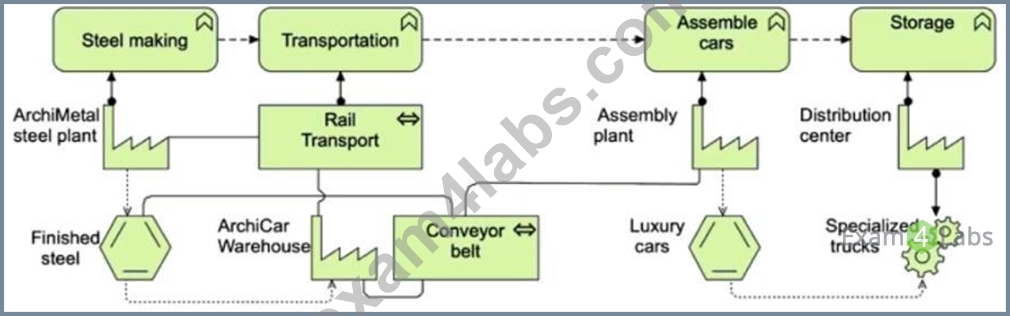
You are a consultant to the CIO. She has asked you to illustrate the end-to-end technology processes at ArchiCar from raw materials to assembled cars ready for delivery.
Which of the following answers provides the best description?
- A.
- B.

- C.

- D.

Answer: B
Explanation:
Physical-layer behavior vs. structure
- The four end-to-end steps (Steel Making → Transportation → Car Assembly → Store Cars) are modeled as Technology Processes (flat, green rectangles with the process icon).
- Each process is assigned to the proper piece of physical infrastructure:
- Steel Making is performed by the ArchiMetal steel plant node (3D box).
- Transportation is performed by the Rail Transport network node.
- Car Assembly runs on the Assembly plant node.
- Store Cars runs on the Distribution center node.
Materials as passive physical structure
- Finished steel and Luxury cars are shown as Materials (hexagons), which is exactly the ArchiMate 3 way to represent tangible goods.
- You can see the produce relationship (dashed arrow) from Steel Making → Finished steel, and the flow of Finished steel into the warehouse.
- Likewise the produce from Car Assembly → Luxury cars flows on to the Specialized Trucks for distribution.
Dedicated warehouse, conveyor, trucks
- The ArchiCar Warehouse, Conveyor belt, and Specialized trucks are all modeled as Technology Nodes (3D boxes) that physically hold or move the material.
- Their connections (solid lines) show how the warehouse feeds the conveyor, which in turn feeds the assembly plant, etc.
Correct use of ArchiMate physical layer notation
- Nodes (3D boxes) are used for all physical equipment/facilities.
- Processes (flat rectangles) for behavior.
- Materials (hexagons) for tangible products.
- Produce and flow relationships for material creation and transfer.
NEW QUESTION # 17
Please read this scenario prior to answering the question
A financial institution runs a Loan Approval process supported by a Loan Processing application and a Risk Assessment application.
The Loan Processing application evaluates loan data using Business Rules stored in a Rules Repository. Risk Assessment retrieves credit scores from an external API.
Both applications run on virtual application servers connected to internal and external networks.
Refer to the scenario.
Which answer is most complete?
- A. Model everything only in the Technology Layer.
- B. Model only application components.
- C. Model Loan Approval as a Business Process served by Application Services realized by Application Functions accessing Data Objects (Loan Request, Risk Report, Business Rules), deployed on Virtual Nodes connected via Communication Networks.
- D. Use association relationships only to show credit bureau integration.
Answer: C
NEW QUESTION # 18
Please read this scenario prior to answering the question
The ArchiSurance enterprise document management solution plays a crucial role in supporting a large number of document types and managing a high volume of document-based transactions each day. Given its business-critical nature, the document management solution is hosted redundantly across two geographically separate data center sites: Site A and Site B. Both sites are configured identically to ensure seamless operations.
Each site has a highly available data center network (DCN) that connects to the resilient ArchiSurance wide area network (WAN). Each claim management server is connected to its respective site's DCN, forming a converged network that interconnects servers and storage arrays. A dedicated physical storage array is allocated to the claim management application within each DCN. Additionally, each site houses four powerful physical servers exclusively dedicated to the claim management application. Among these servers, one remains on standby at any given time, while the other three take on specific roles in hosting the document, workflow, and application engines.
The standby server is responsible for monitoring the behavior of the other servers, providing a logging and reporting service. The active servers regularly transmit data to facilitate this monitoring functionality. In the event of a server failure, the standby server steps in to perform resource reallocation, replacing the faulty server. However, this task requires manual intervention from a system administrator to reconfigure the logging and reporting service to adapt to the new environment.
Refer to the Scenario
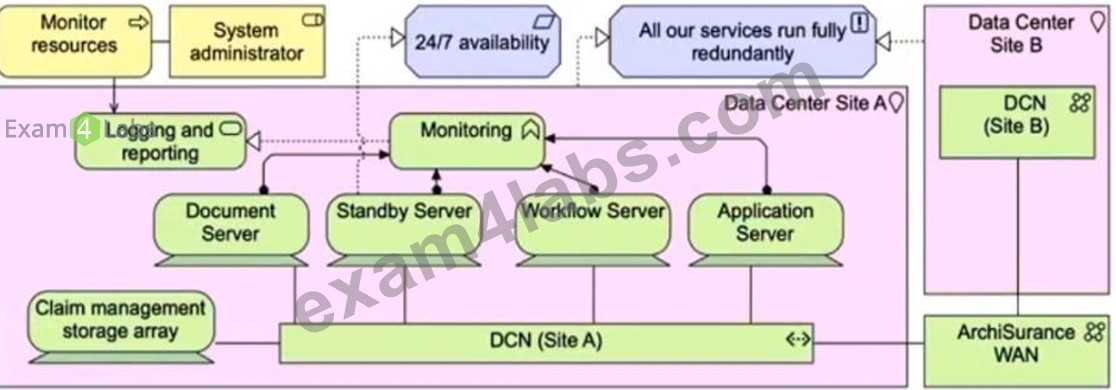
The IT manager has asked you to model the hardware and networks that support the document management solution. This includes capturing the infrastructure components such as data center sites, servers, storage, and networks. Additionally, you are expected to outline the necessary functionality and services required to enable failover within a server cluster. Given that both data centers share an identical configuration, it is sufficient for Site B to only show the associated networking, Which of the following is the best answer?
- A.

- B.

- C.

- D.
Answer: B
Explanation:
Business Layer
- System Administrator is shown as a Business Actor (stick-figure badge).
- Monitor resources is a Business Function (chevron badge) assigned to the System Administrator.
Motivation
- "24/7 availability" is modeled as a Goal,
- "All our services run fully redundantly" as a Requirement.
- Both link into the technology-layer failover design.
Technology Layer
- Monitoring is a Technology Function (up-arrow badge) realized by the standby server.
- Logging and reporting is a Technology ("infrastructure") Service (circle badge) offered by that same node.
- The four physical machines (Document, Workflow, Application, Standby Servers) are all Technology Nodes (the 3D-style server shapes).
- The claim storage is a Technology Artifact (cylinder); the DCNs and WAN are Technology Network elements.
Locations
- Both sites are captured as Location elements (the pin icon), but only Site B's networking is shown to avoid unnecessary duplication.
Fail-over Flow
- Arrows from the active servers into the Monitoring function capture the regular "heartbeat."
- The standby node realizes Monitoring and Logging/Reporting, and a manual triggering relationship back to the System Administrator models the human re-configuration step.
NEW QUESTION # 19
Please read this scenario prior to answering the question
An airline operates a Flight Scheduling process supported by a Scheduling Engine and Crew Management application.
Flight schedules and staff availability are stored in separate databases. Both applications run in redundant server clusters connected via dual LAN switches and independent storage arrays.
Refer to the scenario.
Which option best represents the relationships across layers?
- A. Use Aggregation only for all relationships.
- B. Model Flight Scheduling as a Business Process served by Application Services realized by Application Functions assigned to Application Components, accessing Data Objects, deployed on Server Nodes connected through Communication Networks to Storage Devices.
- C. Model applications only as Technology Nodes.
- D. Model crew availability as a Business Actor.
Answer: B
NEW QUESTION # 20
Please read this scenario prior to answering the question
The ArchiSurance enterprise document management solution plays a crucial role in supporting a large number of document types and managing a high volume of document-based transactions each day. Given its business- critical nature, the document management solution is hosted redundantly across two geographically separate data center sites: Site A and Site B. Both sites are configured identically to ensure seamless operations.
Each site has a highly available data center network (DCN) that connects to the resilient ArchiSurance wide area network (WAN). Each claim management server is connected to its respective site's DCN, forming a converged network that interconnects servers and storage arrays. A dedicated physical storage array is allocated to the claim management application within each DCN. Additionally, each site houses four powerful physical servers exclusively dedicated to the claim management application.
Among these servers, one remains on standby at any given time, while the other three take on specific roles in hosting the document, workflow, and application engines.
The standby server is responsible for monitoring the behavior of the other servers, providing a logging and reporting service. The active servers regularly transmit data to facilitate this monitoring functionality. In the event of a server failure, the standby server steps in to perform resource reallocation, replacing the faulty server. However, this task requires manual intervention from a system administrator to reconfigure the logging and reporting service to adapt to the new environment.
Refer to the Scenario
The IT manager has asked you to model the hardware and networks that support the document management solution. This includes capturing the infrastructure components such as data center sites, servers, storage, and networks. Additionally, you are expected to outline the necessary functionality and services required to enable failover within a server cluster. Given that both data centers share an identical configuration, it is sufficient for Site B to only show the associated networking.
Which of the following is the best answer?
- A. A diagram of a server AI-generated content may be incorrect.

- B. A diagram of a server AI-generated content may be incorrect.

- C. A diagram of a server AI-generated content may be incorrect.

- D. A diagram of a software server AI-generated content may be incorrect.

Answer: A
Explanation:
We need to identify the most accurate and complete model that represents:
* Infrastructure Components- Includingdata centers, servers, storage arrays, and networks.
* Failover Capabilities- Showing thestandby server's rolein monitoring and switching functionality upon failure.
* Redundant Setup- Ensuring therepresentation of both data centers (Site A and Site B), with Site B showing only networking.
* Interconnectivity- Betweenservers, DCN, and WAN.
Why D is the Best Choice:
#All required infrastructure components are included, such as:
* Physical servers(Document, Workflow, and Application Servers).
* Standby Serverfor failover.
* Claim Management Storage Array.
* DCN (Data Center Network)forSite A and Site B.
* ArchiSurance WANfor external connectivity.
#The Standby Server is correctly linked to logging, monitoring, and reporting, showing its role in monitoring and failover.
#Networking is modeled properly:
* Both Site A and Site B have a DCN, correctly interconnecting storage and servers.
* Site B does not duplicate servers but represents networking, as per the scenario.
#Functionality of Failover is Modeled Accurately:
* Monitoring and reporting services are depicted.
* Manual intervention by a system administratoris present.
Why Not A, B, or C?
* A:Does not fully capture thenetwork and storage relationshipsclearly.
* B:Similar to A butmisses some essential network connections.
* C:Incorrectfailover representation, andnetworking elements are not clearly depicted.
NEW QUESTION # 21
Please read this scenario prior to answering the question
ArchiCar has been a market leader in the premium priced luxury car sector for the last decade. Its product leadership strategy has brought superior products to market, and enabled ArchiCar to achieve premium prices for its cars. This strategy has been widely successful in the past, but recently competitors have been offering comparable products and taking significant market share.
The governing board of ArchiCar has identified opportunities in emerging markets where the ArchiCar brand is associated with luxury and high performance products, but is thought to be too expensive for mass-market success. Based on this assessment, the board has made the decision to setup a subsidiary company to mass-produce affordable cars locally. This will be achieved by focusing on a strategy of operational excellence. Such a strategy is ideal for such markets where customers value cost over other factors.
To facilitate this strategic transformation, the project has been divided into multiple phases within a five-year program. The initial phase, known as "Achieving Operational Excellence," is underway. The engineering team has begun devising an action plan to drive the necessary changes and outlining the technological conditions that must be met. The product architect has identified three current capabilities - industry-leading engineering, high-quality materials sourcing, and cutting-edge focussed R&D - along with their contributions to the new production philosophy.
Moving forward, it has been determined that two out of the three current capabilities require revision. Materials sourcing needs to be adjusted to meet optimization demands, and R&D targets must align with future goals to enable affordable production. Additionally, process engineering is introduced as a fourth capability to shift the company's focus from products to a process-oriented approach.
The Enterprise Architecture team has been tasked with migration planning, and identifying key work packages and deliverables. They have identified two transition states between the current and future scenario. The first transition aims to adjust current capabilities, including revising the R&D approach and procurement strategy. The second transition aims to shift from a product- centric mindset to a process-focused approach and adjust materials sourcing accordingly. It is important to consider existing supplier contracts that cannot be immediately canceled during this process.
Refer to the Scenario
You have been asked to model parts of the overall scenario, including migration planning, the motivations driving the migration, and the work packages necessary to achieve the desired deliverables.
Which of the following answers best describes the scenario?
- A.

- B.

- C.

- D.

Answer: A
Explanation:
This diagram is the only one that cleanly captures all of the required pieces:
- Migration Program at the top, showing the three sequential projects (Phase 1 merger → Phase
2 merger → Phase-out old applications).
- Work packages ("TraPri application implemented and tested," "Active TraPri application" for Phase 1; "Recon 2.0 application implemented and tested," "Back-up applications phased out" for Phase 2) tied into each project.
- Two distinct transition plateaus ("1. Merged Trading & Pricing applications" and "2. Merged TraPi application & Reconciliation application").
- A clear baseline on the left (Trading, Pricing, Reconciliation apps) and the final target applications on the right (TraPi and Recon 2.0).
NEW QUESTION # 22
......
The ArchiMate 3 modeling language is a widely accepted standard for enterprise architecture modeling. It provides a comprehensive framework for describing and visualizing complex systems, processes, and relationships within an organization. The Open Group OGA-032 (ArchiMate 3 Part 2) Certification Exam is an essential certification for professionals who want to demonstrate their expertise in using the ArchiMate 3 modeling language to develop effective enterprise architectures.
Pass Your ArchiMate 3 Foundation OGA-032 Exam on Jul 29, 2026 with 20 Questions: https://www.exam4labs.com/OGA-032-practice-torrent.html
OGA-032 Free Exam Study Guide! (Updated 20 Questions): https://drive.google.com/open?id=1bgeHYvoWUqXF9Js2pQEEDOnCWYre12gB