

2026 Updated Verified Databricks-Machine-Learning-Professional dumps Q&As - Pass Guarantee or Full Refund
Databricks-Machine-Learning-Professional PDF Questions and Testing Engine With 193 Questions
NEW QUESTION # 45
A machine learning engineer is attempting to create a webhook that will trigger a Databricks Job job_id when a model version for model model transitions into any MLflow Model Registry stage.
They have the following incomplete code block: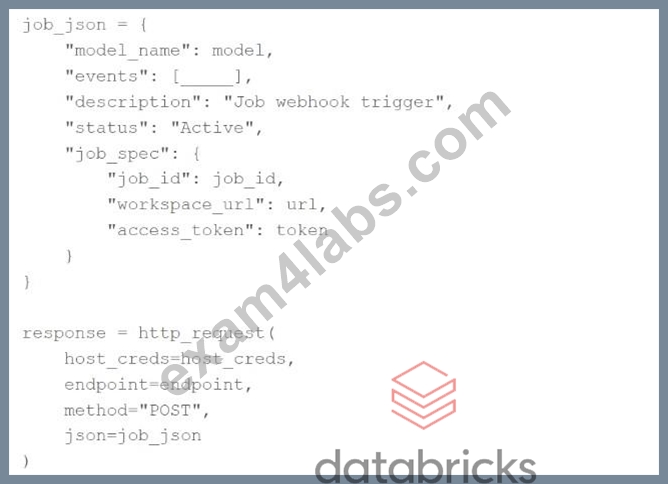
Which of the following lines of code can be used to fill in the blank so that the code block accomplishes the task?
- A. "MODEL_VERSION_TRANSITIONED_TO_STAGING"
- B. "MODEL_VERSION_TRANSITIONED_TO_PRODUCTION"
- C. "MODEL_VERSION_TRANSITIONED_TO_STAGING", "MODEL_VERSION_TRANSITIONED_TO_PRODUCTION"
- D. "MODEL_VERSION_TRANSITIONED_STAGE"
- E. "MODEL_VERSION_CREATED"
Answer: A
NEW QUESTION # 46
Which approach is best for scoring large historical datasets?
- A. Real-time REST API
- B. Local Python script
- C. Batch inference with Spark
- D. Manual predictions
Answer: C
Explanation:
Spark allows distributed batch scoring across massive datasets.
NEW QUESTION # 47
What does an Estimator do in Spark ML?
- A. Transforms a dataset
- B. Stores features
- C. Trains a model using data
- D. Evaluates model performance
Answer: C
Explanation:
An Estimator learns from data and produces a Transformer.
NEW QUESTION # 48
A machine learning engineer wants to deploy a model for real-time serving using MLflow Model Serving. For the model, the machine learning engineer currently has one model version in each of the stages in the MLflow Model Registry. The engineer wants to know which model versions can be queried once Model Serving is enabled for the model.
Which of the following lists all of the MLflow Model Registry stages whose model versions are automatically deployed with Model Serving?
- A. Staging. Production
- B. Production
- C. None. Staging. Production. Archived
- D. Staging. Production. Archived
- E. [None. Staging. Production
Answer: A
NEW QUESTION # 49
A machine learning engineering team wants to build a continuous pipeline for data preparation of a machine learning application. The team would like the data to be fully processed and made ready for inference in a series of equal-sized batches. Which tool can be used to provide this type of continuous processing?
- A. Spark UDFs
- B. Structured Streaming
- C. MLflow
- D. Delta Lake
Answer: A
NEW QUESTION # 50
A machine learning engineer has registered a sklearn model in the MLflow Model Registry using the sklearn model flavor with UI model_uri.
Which of the following operations can be used to load the model as an sklearn object for batch deployment?
- A. mlflow.spark.load_model(model_uri)
- B. mlflow.sklearn.load_model(model_uri)
- C. mlflow.sklearn.read_model(model_uri)
- D. mlflow.pyfunc.load_model(model_uri)
- E. mlflow.pyfunc.read_model(model_uri)
Answer: D
NEW QUESTION # 51
A machine learning engineer needs to select a deployment strategy for a new machine learning application. The machine learning application requires central prediction computation and exceedingly fast results, but only a handful of predictions need to be computed at a time. Which deployment strategy can be used to meet these requirements?
- A. Batch
- B. Real-time
- C. Edge/on-device
- D. Streaming
Answer: B
Explanation:
Real-time deployment is the appropriate strategy when predictions need to be computed centrally with very low latency, even if only a small number of predictions are required at a time. This ensures fast responses for applications requiring immediate inference.
NEW QUESTION # 52
A Machine Learning Engineer is setting up Databricks Lakehouse Monitoring to issue alerts based on IoT sensors that monitor various water conditions at a high tech hydroponic farm.
Specifically:
- pH sensors
- Records acidity/alkalinity on a logarithmic scale from 0 to 14
- Pump status monitor
- Records the current status of the pump as "on", "off", "maintenance",
"fault", or "clean"
- Electrical Conductivity (EC) sensors
- Records nutrient level of the water as "very rich", "rich", "medium",
"poor", "very poor"
What are the appropriate drift metrics for each of the given sensor types?
- A. pH: Kolmogorov-Smirnov (KS), pump status: Chi-squared, EC sensor: Jensen-Shannon distance.
- B. pH: Chi-squared, pump status: Kolmogorov-Smirnov (KS), EC sensor: Wasserstein distance.
- C. pH: Jenson-Shannon distance, pump status: Kolmogorov-Smirnov (KS), EC sensor: Chi-squared.
- D. pH: Jensen-Shannon distance, pump status: Wasserstein distance, EC sensor: Kolmogorov- Smirnov (KS).
Answer: A
Explanation:
pH readings are continuous numerical values, so the Kolmogorov-Smirnov test is appropriate for detecting distribution shifts. Pump status is a nominal categorical variable, making the chi- squared test suitable for identifying changes in category frequencies. Electrical Conductivity levels are categorical with ordered labels, and Jensen-Shannon distance effectively measures distributional changes in such categorical probability distributions.
NEW QUESTION # 53
A Data Scientist needs to analyze drift detection results from Databricks Lakehouse Monitoring.
The system has generated both profile metrics and drift metrics tables. The scientist needs to identify baseline drift in numerical features by comparing current data against a baseline from 6 months ago. Which combination of table columns and values indicates baseline drift in a numerical feature?
- A. drift_type = "BASELINE", ks_test.p_value < 0.05, and wasserstein_distance > 0.1.
- B. drift_type = "BASELINE", chi_squared_test.p_value < 0.05, and js_distance > 0.2.
- C. window_cmp pointing to baseline time window and tv_distance > 0.5 with any drift_type value.
- D. log_type = "BASELINE" in profile metrics table with population_stability_index > 0.2 in drift metrics table.
Answer: A
Explanation:
Baseline drift is identified in the drift metrics table by setting drift_type to BASELINE, and for numerical features the drift statistics are the KS test (ks_test with a p-value indicating a statistically significant distribution change) and a numeric distance metric such as wasserstein_distance.
NEW QUESTION # 54
A Machine Learning Engineer is responsible for maintaining a fraud detection model deployed on Databricks. They want to implement a retraining pipeline that automatically starts when the model's F1 score drops below a threshold or when input feature distributions change significantly.
Which two actions should the engineer take to implement this automated retraining? (Choose two.)
- A. Configure these alerts to send webhook notifications that trigger the model training job.
- B. Use MLflow to manually log metrics and retrain the model offline.
- C. Use Databricks SQL to create alerts on model performance and data drift metrics stored in Delta tables.
- D. Set up a manual retraining schedule to run every week regardless of alerts.
- E. Schedule a recurring query on the Lakehouse monitoring table.
Answer: A,C
Explanation:
Databricks Lakehouse Monitoring stores model performance and data drift metrics in Delta tables, which can be monitored using Databricks SQL alerts. By creating alerts on F1 score degradation or significant feature drift and configuring those alerts to send webhook notifications, the engineer can automatically trigger a retraining job whenever predefined conditions are met, enabling event-driven, automated retraining aligned with MLOps best practices.
NEW QUESTION # 55
A data scientist has computed updated feature values for all primary key values stored in the Feature Store table features. In addition, feature values for some new primary key values have also been computed. The updated feature values are stored in the DataFrame features_df. They want to replace all data in features with the newly computed data. Which of the following code blocks can they use to perform this task using the Feature Store Client fs?
- A.

- B.

- C.
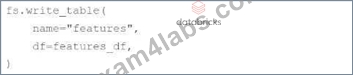
- D.

- E.

Answer: B
NEW QUESTION # 56
Which of the following describes the purpose of the context parameter in the predict method of Python models for MLflow?
- A. The context parameter allows the user to specify which version of the registered MLflow Model should be used based on the given application's current scenario
- B. The context parameter allows the user to provide the model with completely custom if-else logic for the given application's current scenario
- C. The context parameter allows the user to include relevant details of the business case to allow downstream users to understand the purpose of the model
- D. The context parameter allows the user to provide the model access to objects like preprocessing models or custom configuration files
- E. The context parameter allows the user to document the performance of a model after it has been deployed
Answer: A
NEW QUESTION # 57
A machine learning engineer needs to deliver predictions of a machine learning model in real- time. However, the feature values needed for computing the predictions are available one week before the query time. Which feature is a benefit of using a batch serving deployment in this scenario rather than a real-time serving deployment where predictions are computed at query time?
- A. There is no advantage to using batch serving deployments over real-time serving deployments
- B. Batch serving has built-in capabilities in Databricks Machine Learning
- C. Querying stored predictions can be faster than computing predictions in real-time
- D. Computing predictions in real-time provides more up-to-date results
- E. Testing is not possible in real-time serving deployments
Answer: B
NEW QUESTION # 58
A data scientist set up a machine learning pipeline to automatically log feature importance data from a CSV with each run. They now want to view the feature importance data in Databricks.
Which location in Databricks will show this data?
- A. The Data section of the MLflow Run page/span>
- B. The Artifacts section of the MLflow Experiment page
- C. The Artifacts section of the MLflow Run page
- D. The MLflow Model Registry Model page
Answer: C
Explanation:
When a data scientist logs feature importance data (e.g., as a CSV or JSON file) using MLflow, it is stored as an artifact of that specific run. These artifacts are visible under the Artifacts section of the MLflow Run page in Databricks, where users can view or download the logged files associated with that particular experiment run.
NEW QUESTION # 59
A data scientist wants to track the runs of their random forest model. The data scientist is changing the number of trees and the maximum depth of the trees in the forest across each run.
They write the following code block:
Which Python object type does params need to be an instance of?
- A. list
- B. array
- C. PySpark DataFrarne
- D. dict
Answer: D
Explanation:
The params variable must be a dictionary (dict) because mlflow.log_params() expects a dictionary where each key-value pair represents a parameter name and its corresponding value.
Additionally, the model instantiation RandomForestRegressor(**params) also requires params to be a dictionary to unpack the parameters correctly.
NEW QUESTION # 60
Why are Delta tables often used to store machine learning features?
- A. They reduce model size
- B. They support schema enforcement and time travel
- C. They allow faster GPU training
- D. They replace Spark DataFrames
Answer: B
Explanation:
Delta Lake provides:
ACID transactions
time travel
schema enforcement
These are essential for reproducible ML pipelines.
NEW QUESTION # 61
A data scientist has run the following line of code to create a Feature Store table:
Which statement correctly describes the data in the Feature Store table new_table?
- A. The data in new_table is the customer-related features from df
- B. The data in new_table is exactly the same as the data in df
- C. There is no data in new_table
- D. The data in new_table is the values in column customer_id from df
Answer: C
Explanation:
The fs.create_table() command defines metadata for a Feature Store table, such as its name, primary key, schema, and description - but it does not insert any data into the table. This command simply registers an empty table structure based on the provided schema (df.schema).
To populate the table with data, a separate fs.write_table() or equivalent write operation must be executed afterward.
NEW QUESTION # 62
A Machine Learning Engineer has a computer vision model in Databricks Model Serving that obscures sensitive data from images. Internal teams use the model throughout the work week when they request access to new files. Recently model users complained that the model takes much longer in the morning. This coincides with when people arrive at work and request files for the day. When the engineer reviews the endpoint health metrics, they see P50 model latency peaks around 9AM at 20 seconds. Request rate also peaks at 9AM at 15 requests/second. The GPU utilization is over 60%, GPU memory usage over 50%, and provisioned concurrency at 4 throughout the day. What can the engineer do to reduce user wait time when request rate peaks at 9AM each morning?
- A. The endpoint is constrained by the GPU. Scale the endpoint vertically by changing the endpoint workload_type from "GPU_SMALL" to "GPU_MEDIUM".
- B. The endpoint is constrained by its ability to handle simultaneous requests. Define a rate_1imit on the endpoint to spread out the requests over the course of the day.
- C. The endpoint is constrained by its ability to handle simultaneous requests. Enable "scale_to_zero" on the endpoint to spin up additional endpoints quickly to handle the requests.
- D. The endpoint is constrained by its ability to handle simultaneous requests. Scale the endpoint horizontally by editing the endpoint workload_size from "Small" to "Medium" to increase the model concurrency.
Answer: D
Explanation:
The symptoms indicate a concurrency bottleneck during the 9AM traffic spike: request rate increases sharply, latency jumps, and the endpoint is already running at a fixed provisioned concurrency of 4. Increasing workload_size scales the endpoint horizontally to handle more concurrent requests, reducing queueing and bringing down user-perceived wait time during peak demand.
NEW QUESTION # 63
A machine learning engineer has developed a model and registered it using the FeatureStoreClient fs. The model has model URI model_uri. The engineer now needs to perform batch inference on customer-level Spark DataFrame spark_df, but it is missing a few of the static features that were used when training the model. The customer_id column is the primary key of spark_df and the training set used when training and logging the model.
Which of the following code blocks can be used to compute predictions for spark_df when the missing feature values can be found in the Feature Store by searching for features by customer_id?
- A. fs.score_batch(model_uri, spark_df)
- B. df = fs.get_missing_features(spark_df, model_uri)
fs.score_model(model_uri, df) - C. df = fs.get_missing_features(spark_df, model_uri)
fs.score_batch(model_uri, df) - D. fs.score_model(model_uri, spark_df)
- E. df = fs.get_missing_features(spark_df)
fs.score_batch(model_uri, df)
Answer: A
NEW QUESTION # 64
A machine learning engineer has developed a model and registered it using the FeatureStoreClient fs. The model has model URI model_uri. The engineer now needs to perform batch inference on customer-level Spark DataFrame spark_df, but it is missing a few of the static features that were used when training the model. The customer_id column is the primary key of spark_df and the training set used when training and logging the model.
Which of the following code blocks can be used to compute predictions for spark_df when the missing feature values can be found in the Feature Store by searching for features by customer_id?
- A. fs.score_batch(model_uri, spark_df)
- B. fs.score_batch(model_uri, df)
- C. df = fs.get_missing_features(spark_df, model_uri)
fs.score_model(model_uri, df) - D. df = fs.get_missing_features(spark_df, model_uri)
fs.score_batch(model_uri, df)
df = fs.get_missing_features(spark_df) - E. fs.score_model(model_uri, spark_df)
Answer: A
NEW QUESTION # 65
A machine learning engineer has detected that concept drift is occurring in a production machine learning application. Which result is the impact of concept drift?
- A. The model's latency will decrease
- B. The model's efficacy will increase
- C. The model's efficacy will decrease
- D. The model's latency will increase
Answer: C
Explanation:
Concept drift occurs when the relationship between input features and the target variable changes over time. This leads to a decrease in the model's efficacy, as the model is no longer accurately capturing the underlying data patterns it was trained on.
NEW QUESTION # 66
A data scientist has developed a model to predict whether or not it will rain using the expected temperature and expected cloud coverage. However, the proportion of days where it actually rains has increased dramatically from the proportion in the data on which the model was trained.
Which type of drift is present in the above scenario?
- A. Prediction drift
- B. Concept drift
- C. Label drift
- D. Feature drift
Answer: C
Explanation:
Label drift occurs when the distribution of the target variable (label) changes over time while the relationship between features and the label remains the same. In this scenario, the proportion of days when it rains (the label) has changed significantly compared to the training data, indicating label drift.
NEW QUESTION # 67
......
Exam Engine for Databricks-Machine-Learning-Professional Exam Free Demo & 365 Day Updates: https://www.exam4labs.com/Databricks-Machine-Learning-Professional-practice-torrent.html
Test Engine to Practice Test for Databricks-Machine-Learning-Professional Valid and Updated Dumps: https://drive.google.com/open?id=1bu78029B6SCYjNho4fF8BlDYh4zDtUW3