

Go to DEX-450 Questions - Try DEX-450 dumps pdf
Dumps Practice Exam Questions Study Guide for the DEX-450 Exam
Salesforce DEX-450 is a certification exam that is designed to test the knowledge and skills of developers in programmatic development using Apex and Visualforce in Lightning Experience. DEX-450 exam is intended for developers who have experience in building custom applications on the Salesforce platform and want to demonstrate their expertise in programmatic development using Apex and Visualforce.
NEW QUESTION # 89
Which data structure is returned to a developer when performing a SOSL search?
- A. A list of lists of sObjects.
- B. A list of sObjects.
- C. A map of sObject types to a list oflists of sobjects
- D. A map of sObject types to a list of sObjects
Answer: A
NEW QUESTION # 90
What is the result of the following code?
- A. The record will not be created and an exception will be thrown.
- B. The record will be created and no error will be reported.
- C. The record will not be created and no error will be reported.
- D. The record will be created and a message will be in the debug log.
Answer: C
NEW QUESTION # 91
What should a developer do to check the code coverage of a class after running all tests?
- A. View the Code Coverage column in the list view on the Apex Classes page.
- B. View the code coverage percentage for the class using the Overall Code Coverage panel in the Developer Console Tests tab,
- C. Select and run the class on the Apex Test Execution page in the Developer Console.
- D. View the Class Test Percentage tab on the Apex Class list view in Salesforce Setup.
Answer: B
Explanation:
To check the code coverage of a class after running all tests, a developer can use the Developer Console.
Option B: View the code coverage percentage for the class using the Overall Code Coverage panel in the Developer Console Tests tab.
Correct Method.
In the Developer Console, navigate to the Tests tab.
After running tests, the Overall Code Coverage panel displays code coverage statistics.
You can see the coverage percentage for individual classes.
There is no Class Test Percentage tab on the Apex Class list view in Salesforce Setup.
Code coverage is not displayed there.
Option C: View the Code Coverage column in the list view on the Apex Classes page.
Incorrect.
The Code Coverage column is not displayed by default in the Apex Classes list view.
Code coverage details are accessed via the Developer Console or Apex Test Execution.
Option D: Select and run the class on the Apex Test Execution page in the Developer Console.
Partially Correct but Not the Best Answer.
While you can run tests from the Apex Test Execution page, it doesn't directly show code coverage for individual classes.
The best place to view code coverage is the Overall Code Coverage panel.
Conclusion:
The developer should view the code coverage percentage in the Developer Console's Overall Code Coverage panel, which is Option B.
Reference:
Checking Code Coverage in the Developer Console
Running and Monitoring Tests
Incorrect Options:
Option A: View the Class Test Percentage tab on the Apex Class list view in Salesforce Setup.
Incorrect.
NEW QUESTION # 92
A developer creates a custom controller and custom Visualforce page by using the following code block:public class myController {public String myString;public String getMyString() {return 'getmyString';}public String getStringMethod1() {return myString;}public String getStringMethod2() {if (myString == null)myString = 'Method2';return myString;}}{!myString}, {!StringMethod1}, {!StringMethod2}, {!myString}What does the user see when accessing the custom page?
- A. GetMyString , , Method2 , getMystring
- B. , , Method2 , getMyString
- C. , , Method2,
- D. GetMyString , , ,
Answer: A
NEW QUESTION # 93
An Approval Process is defined In the Expense__item__c object. A business rule dictates that whenever a ... clients the Status to Submitted on an Expense_Item__c record related to the expense report must enter the approval process individually.
A developers asked to explore if this automation can be implemented without writing any Apex code.
Which statement is true regarding this automation request?
- A. This can only be automated with Apex code.
- B. This approval step cannot be automated and must be done manually.
- C. The developer can use Einstein Next Best Actions
- D. The developer can use a record triggered flow with Actions.
Answer: A
NEW QUESTION # 94
Universal Containers wants Opportunities to no longer be editable when reaching the Closed/Won stage.
How should a developer accomplish this?
- A. Use Flow Builder.
- B. Use a validation rule.
- C. Use the Process Automation settings.
- D. Mark fields as read-only on the page layout.
Answer: B
NEW QUESTION # 95
In the Lightning Component framework, where is client-side controller logic contained?
- A. JavaScript
- B. Visualforce
- C. HTML
- D. Apex
Answer: A
NEW QUESTION # 96
A developer completed modifications to a customized feature that is comprised of two elements:
* Apex trigger
* Trigger handler Apex class
What are two factors that the developer must take into account to properly deploy the modification to the production environment?
Choose 2 answers
- A. At least one line of code must be executed for the Apex trigger.
- B. Apex classes must have at least 75% code coverage org-wide.
- C. All methods in the test classes must use @isTest.
- D. Test methods must be declared with the testMethod keyword.
Answer: A,B
Explanation:
When deploying Apex code to a production environment, certain requirements must be met regarding test coverage and annotations.
Option B: Apex classes must have at least 75% code coverage org-wide.
Correct Requirement.
Salesforce requires that all Apex classes and triggers have a combined code coverage of at least 75% before deployment to production.
This means that, across all Apex code in the org, at least 75% of the code must be covered by test methods.
Every trigger must have some test coverage, even if the overall code coverage is above 75%.
Specifically, triggers must have at least 1% code coverage.
Test methods should be annotated with @isTest.
However, it's not mandatory that all methods in a test class use @isTest; helper methods within test classes can be private or public methods without the annotation.
Only the test methods themselves need the @isTest annotation.
The testMethod keyword is deprecated but still supported.
The preferred approach is to use the @isTest annotation.
Using testMethod is not recommended for new code.
Reference:
Code Coverage Requirement
Option D: At least one line of code must be executed for the Apex trigger.
Correct Requirement.
Trigger Coverage Requirement
Options Not Suitable:
Option A: All methods in the test classes must use @isTest.
Partially Correct.
Defining Test Methods
Option C: Test methods must be declared with the testMethod keyword.
Outdated Practice.
Deprecated testMethod Keyword
Conclusion:
The two factors the developer must take into account are B (75% code coverage org-wide) and D (At least 1% coverage for triggers).
These are mandatory requirements for deploying Apex code to production.
NEW QUESTION # 97
Universal Containers wants Opportunities to be locked from editing when reaching the Closed/Won stage.
Which two strategies should a developer use to accomplish this? Choose 2 answers
- A. Use a validation rule.
- B. Use a trigger.
Answer: A,B
NEW QUESTION # 98
Which annotation should a developer use on an Apex method to make it available to be wired to a property in a Lightning web component?
- A.

- B.

- C.

- D.

Answer: D
NEW QUESTION # 99
A developer needs to create a custom button for the Account object that, when clicked, will perform a series of calculations and redirect the user to a custom Visualforce page. The developer wants to ensure the Visualforce page matches the Lightning Experience user interface.
What attribute needs to be defined within the <apex:page> tag to meet the requirement?
- A. wizard=true"
- B. lightningStylesheets=''true"
- C. setup="true"
- D. applyHtmlTag="true"
Answer: B
NEW QUESTION # 100
A Lightning component has a wired property, searchResults, that stores a list of Opportunities. Which definition of the Apex method, to which the searchResults property is wired, should be used?
- A. @AuraEnabled(cacheable=true)
public List<Opportunity> search(String term) { /*implementation*/ } - B. @AuraEnabled(cacheable=true)
public static List<Opportunity> search(String term) { /* implementation*/ } - C. @AuraEnabled(cacheable=false)
public List<Opportunity> search(String term) { /*implementation*/ } - D. @AuraEnabled(cacheable=false)
public static List<Opportunity> search(String term) { /*implementation*/ }
Answer: B
NEW QUESTION # 101
What is the value of the Trigger.old context variable in a before insert trigger?
- A. Undefined
- B. null
- C. An empty list of sObjects
- D. A list of newly created sObjects without IDs
Answer: B
Explanation:
Trigger.old in a before insert trigger:
The Trigger.old context variable contains the old version of the records being processed in the trigger.
In a before insert trigger, the records being processed are new and have no prior state in the database, so Trigger.old is null.
This behavior is specific to insert triggers because there is no "old" record to reference before the record is created.
Why is it null?
The Trigger.old variable is only populated for triggers that handle updates or deletions (e.g., before update, after update, before delete, after delete). For insert operations, no previous state of the record exists.
Why not the other options?
A . An empty list of sObjects:
This is incorrect because Trigger.old is not initialized as an empty list for insert triggers-it is simply null.
B . Undefined:
Trigger.old is defined in the trigger context, but it is null for insert operations. Undefined is not a valid Apex state.
D . A list of newly created sObjects without IDs:
This describes Trigger.new in a before insert trigger, not Trigger.old. Trigger.new contains the new records being inserted.
Reference:
Apex Triggers Documentation
Trigger Context Variables
NEW QUESTION # 102
Universal Containers has created a unique process for tracking container repairs. A custom field, status__c, has been created within the container__c custom object. A developer is tasked with sending notifications to multiple external systems every time the value of the status__picklist changes.
Which two tools should the developer use to meet the business requirement and ensure low maintenance of the solution?
Choose 2 answers
- A. Apex callouts
- B. Platform event
- C. Record-Triggered flow
- D. Apex trigger
Answer: A,B
NEW QUESTION # 103
A developer considers the following snippet of code: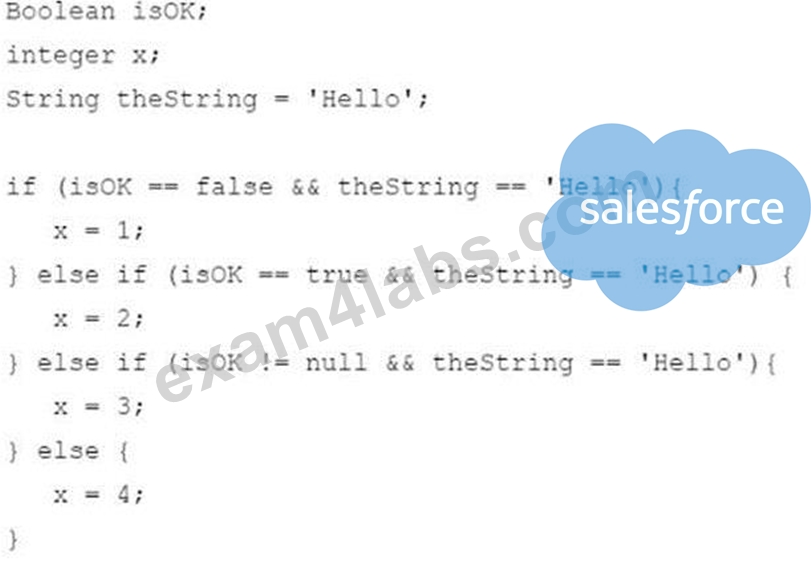
Based on this code, what is the value of x?
- A. 0
- B. 1
- C. 2
- D. 3
Answer: C
NEW QUESTION # 104
Which three statements are true regarding custom exceptions in Apex? (Choose three.)
- A. A custom exception class must extend the system Exception class.
- B. A custom exception class name must end with "Exception".
- C. A custom exception class can implement one or many interfaces.
- D. A custom exception class cannot contain member variables or methods.
- E. A custom exception class can extend other classes besides the Exception class.
Answer: B,C,E
NEW QUESTION # 105
......
Free Salesforce Developer DEX-450 Exam Question: https://www.exam4labs.com/DEX-450-practice-torrent.html
DEX-450 Dumps with Practice Exam Questions Answers: https://drive.google.com/open?id=1x1MtAMXU2uq8st7fL3dpOSOyZh5_3XkA